Chapter 16 bounded the whole spectrum with one
number: every eigenvalue lies in the disc (Corollary 16.4.2). That disc
is centered at ,
and it knows nothing about where in it the eigenvalues
sit. For a matrix that is nearly diagonal the answer
ought to be visible at a glance: the eigenvalues should
sit near the diagonal entries, and the off-diagonal
entries should say how near. This section makes that
precise. It puts one disc around each diagonal entry,
with radius measured from the rest of its row, and
proves that the discs together hold every eigenvalue. It
then sharpens the picture twice: by rescaling the
coordinates, and, for irreducible matrices, by looking
at the boundary.
Throughout, matrices are complex. A
real matrix is read inside , as in Chapter
16 §04, because its eigenvalues may be non-real, and
they are what we want to locate.
Discs
around the diagonal
Here is the situation to keep in mind. Take The row-sum bound gives for every eigenvalue
, a disc of
radius about
. But if the
off-diagonal entries were , the eigenvalues would
be exactly . The off-diagonal entries are a perturbation
of the diagonal matrix, and the natural guess is that
each eigenvalue stays within reach of some diagonal
entry, where the reach of row is measured by the size
of the entries of row off the diagonal. We
give that reach a name.
Around each diagonal entry, draw the disc whose
radius is the total size of the other entries in its
row.
Definition
20.1.1 (Gershgorin Discs)
Let and
. For , the -th Gershgorin
radius of is the real number
the sum over all
other than , and the -th Gershgorin
disc is the closed disc The discs , whose radii
are taken from the
columns of , are the
column discs.
In words: the center of is the diagonal
entry , and
the radius adds up the moduli of the entries of row
that are
not on the diagonal. The disc includes
its boundary circle. A radius may be , and then the disc is
the single point . Since has the same
diagonal as , the
column discs have the same centers as the row discs and,
in general, different radii. The letter is lowercase on
purpose, since is the Rayleigh
quotient, and the plain is a set of complex
numbers, not the bold diagonal matrix .
Some examples, simplest first.
- Diagonal matrices and . For every radius is , because every
off-diagonal entry is , and . The
discs are the eigenvalues. A matrix is the case : the sum defining
is empty, so
. These
degenerate cases are the ones any theorem about the
discs must get exactly right.
- A matrix. For , and , so the row
discs are and . The column discs swap the radii:
and .
- The matrix above. ,
and , so and . The column radii are , and .
Non-example by minimal change. Keep
the radius and move the center to : replace by . For both radii
are and the
modified “discs” are both , which misses both
eigenvalues. The clause that changed is the center, and
the diagonal example shows it is the part that carries
the information: the radius only measures how far the
off-diagonal part can pull an eigenvalue away from
it.
The
theorem
It turns out that the guess is right, with no loss at
all in the constant:
Theorem
20.1.1 (Gershgorin’s Theorem)
Let ,
,
and let be
an eigenvalue of
with eigenvector . If is an index with , then .
Consequently:
- (a) every eigenvalue
of lies in the
union of the row discs;
- (b) every eigenvalue
of lies in the
union of the column discs;
- (c) hence every
eigenvalue lies in the intersection of the two
unions.
Idea. We want to be small for one well-chosen
, so look at row
of and move
the diagonal term across: . The triangle inequality
bounds the right side by , and this becomes
exactly when every . So choose where the eigenvector
is largest in modulus. Then divide by , which
is positive because .
Proof. Let with
, and let
be as in the
statement; such a
exists because a finite set of real numbers has a
largest element. Since , some , so . Row of reads
, that is, Taking moduli and using the triangle
inequality (Theorem 0.6.4), then
for every , Dividing by gives , that is, .
(a) Every
eigenvalue has an eigenvector, and the disc just found
is one of the .
(b) By Proposition 9.10.5
(b), has the
same eigenvalues as . Applying (a) to puts each of them
in .
(c) A point lying
in each of two sets lies in their intersection. This
proves the theorem.
The move in this proof is worth naming, since the
chapter uses it again: choose the dominant
coordinate of an eigenvector, then apply the triangle
inequality to its row. The choice of the
largest coordinate is exactly what lets every be
replaced by without looking at the others.
The theorem recovers Chapter 16’s bound and improves
on it. If , then so (a) implies , and (b) likewise implies
. The union of the discs is never
larger than the row-sum disc, and it is usually much
smaller, because it keeps the centers.
Example
(Discs, eigenvectors, and where each eigenvalue
sits)
Let . Describe the regions
given by Theorem 20.1.1 (a)
and (b). Then check that , and are eigenvectors, and locate each
eigenvalue in the disc the theorem assigns to it.
Solution. From the radii computed
after Definition 20.1.1,
the row discs give the second disc counted twice, and the column
discs give , where the middle
disc lies inside the last. So every eigenvalue lies in
, and also in
. The column
discs have separated the two groups of centers; the row
discs have not.
Multiplying out, so the eigenvalues include , and . These are three
distinct eigenvalues of a matrix, hence three distinct roots of
the degree-
polynomial
(Theorem 9.2.1), so by
Corollary 6.1.4 there
are no others.
- The eigenvector peaks at , and indeed : .
- The eigenvector peaks at , and : .
- The eigenvector has all three coordinates of modulus , so every is a peak and must lie in every row
disc. It does: , so it sits on the
boundary circle of , and it is the
center of the other two.
Both unions pass the test, and the eigenvector tells
us which disc to look in. The row-sum disc
says only that .
Warning. The union is the
claim, not each disc. A single Gershgorin disc
need not contain any eigenvalue. For , , so
the eigenvalues are , while the first row disc is : it
contains neither. Both eigenvalues lie in the second
disc . Nor may the row disc and the column disc of
the same index be intersected:
and are both , and
lies in
neither. Part (c) of the theorem intersects the two
unions.
Quick check. Without computing any
eigenvalue, show that every eigenvalue of has real part at least .
Solution. The row discs are ,
and . A point of the first has , of the second , of the third . By Theorem 20.1.1 (a)
every eigenvalue lies in one of them, so its real part
is at least . In
particular is not
an eigenvalue, and is invertible.
Diagonal
dominance
The last sentence of the Quick check is a pattern. If
lies outside
every disc, then
is not an eigenvalue, and the matrix is invertible. The
point lies
outside
exactly when , which is a condition
on row alone.
Corollary
20.1.2 (Strict Diagonal Dominance Implies
Invertibility)
Let and
.
Call
strictly diagonally dominant (by rows)
if A strictly diagonally dominant matrix is
invertible. The same holds if is strictly diagonally
dominant by columns, that is, if is strictly
diagonally dominant.
Proof. Suppose is strictly diagonally
dominant. For every , , so . Hence lies in no row disc,
and by Theorem 20.1.1 (a) it
is not an eigenvalue. By Theorem 9.2.1, is
invertible, and so is . If instead is strictly
diagonally dominant, then lies in no column disc,
and Theorem 20.1.1 (b)
finishes in the same way.
This is the Lévy–Desplanques
theorem. The word strictly
carries the weight, and the definition asks it of
every row. Examples: is strictly dominant, since
, , ; every diagonal
matrix with non-zero diagonal is, since every radius is
; and a matrix is strictly dominant
exactly when . A minimal change breaks it. has in both rows: it is dominant only weakly,
and it is singular. The converse of the corollary is
false: is
invertible and has zero diagonal. Diagonal dominance is
a certificate of invertibility, cheap to check and often
available, not a characterization.
Hermitian
matrices, and intervals
For a Hermitian the eigenvalues are
real (Theorem 12.2.1),
and so are the diagonal entries, since .
So only the part of each disc on the real line matters,
which is the interval . Theorem 20.1.1 (a)
then says For
the intervals are ,
and , so
every eigenvalue lies in , and is positive definite
by Theorem 13.1.5, since
its eigenvalues are positive; Exercise C1 turns this
into a general criterion. For a Hermitian matrix the row
and column discs coincide, since , so (b) adds
nothing.
Scaling
the discs
The discs depend on the matrix, and the eigenvalues
depend only on its similarity class. So any similarity
that is easy to compute gives new discs for the same
eigenvalues. The cheapest one rescales the
coordinates.
Proposition
20.1.3 (Rescaling the Gershgorin Discs)
Let , let be positive real
numbers, and . Then:
- (a) has entries
. It
has the same diagonal as , and the same
eigenvalues with the same algebraic multiplicities.
- (b) for each .
- (c) Every eigenvalue
of lies in
Proof.
(a) is invertible with
, because every . Multiplying by
a diagonal matrix on the left scales rows and on the
right scales columns, so , and for this is . The matrices
and are similar,
so they have the same characteristic polynomial (Theorem 7.10.3),
hence the same eigenvalues with the same
multiplicities.
(b) By (a) and
,
; sum over .
(c) Apply Theorem 20.1.1 (a) to
and use
(a) and (b).
Taking and the other divides the first radius by and multiplies the
entry inside every other radius by . So scaling shrinks
some discs at the expense of others, and the art is to
shrink the disc we care about while the others can
afford to grow. The same move appeared in Chapter 19
§09, where turned the entries of into row sums.
Solution. By Proposition 20.1.3
(b) with
and ,
the scaled radii are with centers , , . The first disc is
disjoint from the other two exactly when the distance
between the
centers exceeds the sum of the radii: where we multiplied by . For instance
gives and the discs the second counted twice, which are disjoint
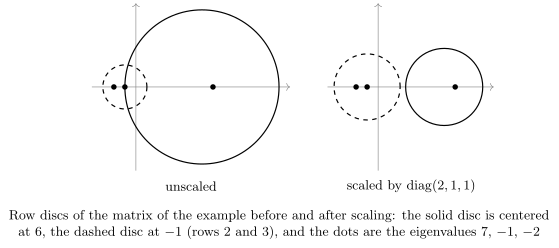
since . The eigenvalues , , are distributed one in
the first disc and two in the second, as the figure
shows.
Scaling has bought a picture in which the eigenvalues
fall into two groups, one near and two near . What it has
not yet bought is the statement that
the first disc contains exactly one eigenvalue. Theorem 20.1.1 says
only that the union holds all three, and nothing so far
forbids all three from lying in the second disc. The
counting statement is true, but it needs the eigenvalues
to move continuously as the off-diagonal part is
switched on, and §03 proves it. For a real matrix like
this one, §03 will also show that an isolated disc
centered on the real axis holds a real
eigenvalue.
Eigenvalues on the boundary
Diagonal dominance fails for a matrix that matters.
The second-difference matrix of Chapter 19 §09
has on the
diagonal and
beside it, so for its interior rows have . The discs
pass through , and
Corollary 20.1.2 says
nothing, although is invertible. Only
the first and last rows are strict. What rescues it is
that the rows are linked: the dominant
coordinate of an eigenvector cannot stay in the equality
rows without spreading to the strict ones. The link is
irreducibility, in the sense of Definition 19.2.3, and
by Theorem 19.2.5 it
means that the graph , with an edge whenever , is strongly
connected.
Theorem
20.1.4 (Taussky’s Theorem)
Let , let
be
irreducible, and let be an eigenvalue
of with that is, lies in no open
disc . Then for every : the eigenvalue lies on
the boundary circle of every Gershgorin
disc. Moreover, every eigenvector for has all its
coordinates of the same modulus. The hypothesis holds in
particular when is a boundary
point (Definition 18.3.2) of
.
Idea. Run the proof of Theorem 20.1.1 at a
peak index . The
hypothesis makes the two ends of its
chain of inequalities equal, so every inequality in the
chain is an equality. The second one, , is an equality only if whenever . So the set
of peak indices is closed under following edges of backwards. Strong
connectivity then drags every index into it.
Proof. Let with
, put
and , which is
non-empty.
Claim. If , then , and every with lies in
.
Proof. By the hypothesis and the
chain of inequalities in the proof of Theorem 20.1.1, with
, The two ends agree, so every inequality is an
equality. The first gives , after dividing by . The last says
. Each
term is non-negative, so each is , and forces ,
that is, .
Now let be any
index and fix . By Theorem 19.2.5, has a walk . We show for . For this is . If with , then is an edge, so ;
either , or the Claim applied to puts in . Hence . So :
every coordinate of has modulus , and the Claim gives
for every .
For the last sentence, suppose for some , and put . Every with satisfies , so it lies in and in the union.
Then is an
interior point of the union, not a boundary point. This
proves the theorem.
For the
theorem is empty but true: and the only
eigenvalue is . For the all-ones
matrix , , which is irreducible because every entry is
non-zero, every disc is , and the eigenvalue , with eigenvector , satisfies : it lies on all of the boundary circles at
once, and its eigenvector has equal coordinates, exactly
as the theorem predicts.
The corollary is the one needed: equality in
most rows is allowed, provided one row is strict and the
rows are linked.
Corollary
20.1.5 (Irreducible Diagonal Dominance Implies
Invertibility)
Let and
let
be irreducible, with Then
is invertible.
Proof. Suppose is not invertible. By
Theorem 9.2.1, is an eigenvalue. The
first hypothesis says for every , so Theorem 20.1.4
applies to and gives for every . This contradicts the
second hypothesis. Hence is invertible.
Both hypotheses are needed. is irreducible and
weakly dominant, with no strict row, and it is singular:
its eigenvalue
lies on both circles . Exercise C2 shows that
irreducibility cannot be dropped either.
Example
(The second-difference matrix)
Show that
is invertible for every , and that its eigenvalues lie in the open
interval .
Solution. For , , with
eigenvalue . Let
. (Chapter
19 §09 proved invertibility by exhibiting the inverse,
Proposition 19.9.6;
here the entries alone suffice.) The only non-zero
entries off the diagonal are , so has the edges
and
, and
walking along them reaches every vertex from every
vertex. So is
irreducible by Theorem 19.2.5. Its
rows have and, when ,
for . So everywhere, strictly in
row , and is invertible by Corollary 20.1.5.
is real
symmetric, so its eigenvalues are real, and by Theorem 20.1.1 (a)
they lie in . The value is excluded by
invertibility. The value satisfies for every , so if it were an
eigenvalue, Theorem 20.1.4 would
give ,
which is false. Hence every eigenvalue lies in . In particular
, which
Chapter 19 §09 obtained from its M-matrix structure.
Quick check. The all-ones matrix
is
irreducible, and
is an eigenvalue of it, since has rank . But does not lie on the
circle . Does this contradict Theorem 20.1.4?
Solution. No. The theorem applies
only to an eigenvalue with for every , and : the eigenvalue lies inside every open
disc, so the hypothesis fails and the theorem says
nothing about it. The other eigenvalue, , satisfies ,
and it does lie on every circle.
The picture to take away is this. The union of the
discs holds the spectrum. An eigenvalue sits in the disc
of the row where its eigenvector peaks. Scaling moves
radius from one disc to another. And for an irreducible
matrix, an eigenvalue can reach the outer edge of the
union only by reaching the edge of every disc at once.
§02 replaces the discs by other regions built from the
same entries, and §03 counts the eigenvalues inside a
group of discs.
Exercises
A. Check your
understanding
Exercise
(A1)
- (a) Define the
Gershgorin radius and the disc
, and state
Theorem 20.1.1,
including the statement about the peak coordinate of an
eigenvector.
- (b) True or false:
every Gershgorin disc of contains an eigenvalue
of . Justify your
answer.
- (c) True or false:
every eigenvalue of lies in . Justify your answer.
- (d) True or false:
an invertible matrix is strictly diagonally dominant by
rows or by columns. Justify your answer.
- (e) True or false:
an irreducible matrix with for every is invertible. Justify
your answer.
- (f) Name the method
of proof of Theorem 20.1.1 in one
line.
Solution.
(a) and . If with
and , then ;
hence every eigenvalue lies in , in
, and in the intersection of these
two unions.
(b) False. For
the
eigenvalues are and the first disc is .
(c) False. For
the same matrix both intersections are ,
which misses .
(d) False. is invertible, and
both for rows and for columns.
(e) False. is irreducible,
with , and singular. Corollary 20.1.5
needs one strict row.
(f) Choose the
coordinate of the eigenvector of largest modulus, and
apply the triangle inequality (Theorem 0.6.4) to that
row of .
B. Practice
Exercise
(B1: Deciding invertibility)
Determine which of the following matrices are
invertible. Justify your answers, using the results of
this section where they apply and a direct computation
where they do not.
- (a)
- (b)
- (c)
- (d)
Solution.
(a) The radii are
and the
diagonal moduli , so every row is strictly
dominant. The matrix is invertible by Corollary 20.1.2.
(b) Row has , and rows and have . Every
off-diagonal entry is non-zero, so every edge with is present in the
graph, which is strongly connected, and the matrix is
irreducible (Theorem 19.2.5). It is
invertible by Corollary 20.1.5.
(Indeed its determinant is .)
(c) Every row has
: no row
is strict, so neither corollary applies. Directly, the
matrix is ,
and , while for and . So the
eigenvalues of are , none zero, and the matrix is invertible,
with determinant .
The corollaries give sufficient conditions
only.
(d) Rows and have equality and row
is strict, but
the matrix is singular: its first two rows are equal.
The corollary does not apply because the matrix is
reducible: column
is zero outside row , so no edge leaves
vertex , and there
is no walk from
to .
Exercise
(B2: An interval for a symmetric matrix)
Let .
- (a) Use Theorem 20.1.1 to
find an interval containing every eigenvalue of , and compare it with
the interval given by Corollary 16.4.2.
- (b) Hence show that
is positive
definite, and that lies between and .
Solution.
(a) is real symmetric, so
its eigenvalues are real. The radii are , so the discs
meet in , , , whose union is
. By Theorem 20.1.1 (a),
every eigenvalue lies in . The largest absolute row sum is ,
so Chapter 16’s bound gives only ; the upper ends
agree, but only the discs see that the eigenvalues are
positive.
(b) Every
eigenvalue is at least , so by Theorem 13.1.5. The
determinant is the product of the three eigenvalues,
each in , so
. (In fact .)
Exercise
(B3: Choosing the scaling)
Let .
- (a) Show that the
row disc
meets the other two row discs.
- (b) For with
, find the
scaled radii, and find all for which the first
scaled disc is disjoint from the other two.
- (c) Check that is an
eigenvector of ,
and that its eigenvalue lies in the first scaled disc
for .
Solution.
(a) The discs are
, and . The point lies in the first two,
and in the first
and third.
(b) By Proposition 20.1.3
(b), the radii of are , and , with centers . The first disc
misses the second when , and misses the third when : both
say .
Multiplying by , this is , that is, , so
. At
the discs
touch.
(c) Here so is
an eigenvalue. For the first scaled disc is , which contains . The eigenvector peaks
at the first coordinate, so Theorem 20.1.1
already placed in
; the scaled
theorem places it in the smaller disc.
C. Going deeper
Exercise
(C1: Dominance and definiteness)
- (a) Prove that a
Hermitian matrix
with for every is positive
definite.
- (b) Prove that a
Hermitian irreducible matrix with for
every , strictly
for at least one ,
is positive definite.
- (c) Deduce that for
every and
every real ,
the matrix is positive definite.
Hint for (b): apply (a)’s argument to find where
the eigenvalues can be, and then use Theorem 20.1.4.
Solution.
(a) The diagonal
entries of a Hermitian matrix are real, and so are its
eigenvalues (Theorem 12.2.1).
By Theorem 20.1.1 (a),
each eigenvalue lies in some
, so . A
Hermitian matrix with only positive eigenvalues is
positive definite (Theorem 13.1.5).
(b) As in (a),
every eigenvalue satisfies for some , so it is enough to
show that is not
an eigenvalue. The hypothesis gives for every , since .
If were an
eigenvalue, Theorem 20.1.4 would
give for every , contradicting the
strict row. Hence all eigenvalues are positive and . (This is also
Corollary 20.1.5,
together with the sign information from (a).)
(c) The matrix is
real symmetric, and it differs from only in the entry, which is
. The graph is
unchanged, so for it is irreducible, as shown in Example (The second-difference matrix).
Its rows satisfy , with in row . By (b), it is positive
definite. For
the matrix is with .
Exercise
(C2: Irreducibility cannot be dropped)
- (a) Give a reducible
matrix with for every , strictly in at least
one row, that is singular. Which step of the proof of Theorem 20.1.4 fails
for it?
- (b) Let be irreducible and let
be an
eigenvalue with for every . Prove that the
eigenspace has
dimension .
Hint for (b): given two independent eigenvectors,
form a combination with a zero coordinate.
Solution.
(a) Take from Exercise (B1: Deciding invertibility)
(d): rows and
have equality,
row is strict,
and the first two rows are equal, so is singular. The
eigenvector for has . Its peak set is , and the
Claim of the proof holds: the rows in have equality and their
off-diagonal non-zero entries point into . What fails is the
spreading step. There is no walk from to in , so nothing forces
, and the
strict row is
never reached.
(b) Suppose and are linearly
independent eigenvectors for . Since , choose with , and put .
Then , by
independence, and , so is an eigenvector for
with . But by Theorem 20.1.4 every
eigenvector for has all
coordinates of the same modulus, which is positive
because the vector is non-zero. This contradiction shows
, and because is an
eigenvalue.