After defining a structure, the next step is to look
at the smaller copies of it that sit inside. In the
previous section we showed three times, for , and the
solutions of , that a subset of a known vector space is
itself a vector space, and each time the same few checks
did the work. This section turns that pattern into a
theorem, the subspace test, and makes its three checks a
routine we will use for the rest of the book.
Spaces
inside spaces
Consider the set a plane through the origin in . It contains and , and also their
sum ,
since . Stretching a vector of keeps it in the plane.
So , with the
addition and scalar multiplication of , looks like a
vector space in its own right.
To prove it we could check all eight axioms again.
That is wasteful, and the previous section already
showed why. The axioms (VS1), (VS2) and (VS5)–(VS8) are
equations that hold for all vectors of
, so they hold
in particular for the vectors of . What can go wrong is
different: a sum or a multiple might leave , and the zero vector or
an additive inverse might not lie in . The question of this
section is which of these checks are really needed.
A subspace is a subset that is a vector space in
its own right, using the same addition and scalar
multiplication.
Definition
1.2.1 (Subspace)
Let be a
vector space over . A subset is a
subspace of if is itself a
vector space over when it is
given the addition and the scalar multiplication of
.
For that sentence to make sense, must first be closed
under those two operations:
In words: take the plus and the dot that already has, use them
only on vectors of , and ask whether is a vector space with
them. Nothing new is defined; borrows everything from
. The displayed
condition is what makes the borrowing possible, because
an operation on
must land in : if but , then
addition is not an operation on at all, and the
question of the axioms never arises. Once the condition
holds, the eight axioms are asked of exactly as they were
asked of in the
previous section. In particular must contain
a zero vector of its own, and every
vector of must
have an additive inverse lying in . The field
does not change: a subspace of a space over is again a space over
.
Two words of the definition carry all the weight.
Itself a vector space is the whole
content. The same operations is what
distinguishes a subspace from a subset that merely
happens to be a vector space under some other rule:
with
the operations of Example (Positive Reals with Exotic Operations)
is a vector space and a subset of , but it is not a
subspace of ,
because those are not the operations of .
There is a question hidden in “a zero vector of its
own”. Could have
a zero vector different from the zero vector of ? The proof of the
subspace test below shows that it cannot.
The two extreme cases come first.
Example
(Trivial Subspaces)
Let be a
vector space over . Show that and are subspaces of
, and that the
empty set is not.
Solution. For itself, the restricted
operations are the operations of , and is a vector space by
assumption.
For , the
only sum is by (VS3), and for every by Theorem 1.1.6. So
both operations stay in , and with them is the
zero space, a vector space as noted in the previous
section.
For ,
axiom (VS3) demands that some element exists in the set. The
empty set has no elements, so (VS3) fails and is not a
subspace.
The subspace is the
zero subspace. A subspace other than
is called
proper. The zero subspace is small, but
it is the answer to many questions later: the solutions
of a system with only the trivial solution, or the
intersection of two lines through the origin that are
not equal.
The
subspace test
The following theorem says that three checks suffice.
Two of them are the closure conditions of the
definition, and the third replaces all of the
axioms.
Theorem
1.2.1 (Subspace Test)
Let be a
vector space over
and let . Then
is a subspace of
if and only if the following three conditions hold.
- (1) , where is the zero vector of
.
- (2) is closed under
addition: for all .
- (3) is closed under
scalar multiplication: for all and .
Idea. Sort the eight axioms into
two kinds. Six of them, (VS1), (VS2) and (VS5)–(VS8),
say “an equation holds for all
vectors”; they are true in , so they are
automatically true for the fewer vectors in . The other two, (VS3)
and (VS4), say “there exists a vector”,
and a witness must be found inside
. Condition (1)
supplies the zero. For inverses, the results of the
previous section give , so closure under scaling supplies them
for free. For , the only
non-obvious point is that the zero vector of is the zero vector of
; cancellation in
settles it.
Proof. Suppose
is a subspace of
. Conditions (2)
and (3) are the closure condition of Definition 1.2.1. By
(VS3) in , there
is with
for
every ; in
particular . By (VS3) in , also . Hence , and Theorem 1.1.1 in
gives . Therefore , which is
(1).
Suppose (1), (2) and (3) hold. By (2) and (3), addition
and scalar multiplication of restrict to functions
and . We check the axioms for with these
operations.
- (VS1), (VS2), (VS5), (VS6), (VS7) and (VS8) state
that certain equations hold for all vectors and scalars.
They hold for all vectors of , since is a vector space, so
in particular for all vectors of .
- (VS3): by (1), , and for every by (VS3) in .
- (VS4): let . By (3), . By Theorem 1.1.7, , so . Thus
has an additive
inverse in .
Hence is a
vector space over
with the operations of , that is, a subspace of
.
From now on we never check eight axioms for a subset
of a known vector space. We check three things, always
in the same order and with the same wording. This is the
first named move of the chapter.
The three-check move. To show that a
subset of a
vector space is a
subspace:
- make sure is
a subset of (what
are its elements, and do they lie in ?);
- (1) Zero vector. Show by checking that
satisfies the
condition defining . End with “Therefore
.”
- (2) Closed under addition. Let
. Write
down what membership in means for each, then
regroup so
that those conditions appear. End with “This shows that
is closed under
addition.”
- (3) Closed under scalar
multiplication. Let and , and do the same
for . End with
“This shows that
is closed under scalar multiplication.”
- Conclude: “Hence is a subspace of by the subspace test
(Theorem 1.2.1).”
To show that
is not a subspace, one failure
suffices. Check (1) first, since it is the cheapest, and
if it holds, look for a concrete pair of vectors or a
concrete scalar that leads out of .
Warning. The empty set is
never a subspace. It is tempting to check only
(2) and (3). But satisfies
both, vacuously: there are no vectors in it to add or
scale. It fails only (1). So whichever version of the
test you use, do not skip the first condition, and
remember that “” and “
is non-empty” are interchangeable only in the presence
of (3).
Examples:
the three-check move
Every example below follows the move exactly. The
first is the model.
Example
(A Line through the Origin)
Show that is a subspace of
.
Solution. By definition, is a subset of .
(1) Zero vector. The zero vector
satisfies
.
Therefore .
(2) Closed under addition. Let and be in
, so that and . Then
, and Therefore . This shows that is closed under
addition.
(3) Closed under scalar
multiplication. Let and , so
that .
Then , and Therefore . This shows that is closed under scalar
multiplication.
Hence is a
subspace of
by the subspace test (Theorem 1.2.1).
Change the right-hand side from to , and everything
breaks.
Example
(A Line Missing the Origin)
Show that is
not a subspace of .
Solution. Condition (1) fails: the
zero vector has , so . By the subspace test (Theorem 1.2.1),
is not a subspace
of .
The other two conditions fail as well, as we saw in
the previous section: , and . One failure is enough, though, and (1) is
the cheapest to find.
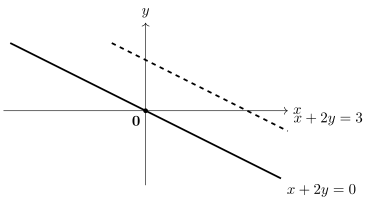
The solid line
passes through the origin; the dashed line is parallel to it and
misses the origin. The line is a translate of a
subspace, a kind of set we will study in Chapter 4, but
it is not a subspace.
The line is
the set of solutions of one homogeneous equation. The
same three checks work for any number of homogeneous
equations, written as one matrix equation.
Example
(Solutions of a Homogeneous System)
Let . Show that is a subspace of
.
Solution. By definition, is a subset of . Recall that ,
so is
a matrix product, and we may use Theorem 0.9.4.
(1) Zero vector. By the zero rule of
Theorem 0.9.4, , where the
first is the
zero column in
and the second is the zero column in . Therefore .
(2) Closed under addition. Let , so that
and . By
distributivity (Theorem 0.9.4), Therefore . This shows that is closed under
addition.
(3) Closed under scalar
multiplication. Let and . By the scalar
rule of Theorem 0.9.4 and Theorem 1.1.6 in
, Therefore . This shows that is closed under scalar
multiplication.
Hence is a
subspace of by
the subspace test (Theorem 1.2.1).
With and , this is Example (A Line through the Origin)
again, and with it is the plane from the start of the
section. The word homogeneous
(right-hand side ) is essential: Example (A Line Missing the Origin)
is a system with right-hand side . This subspace will be
called the null space of in Chapter 3.
Next, polynomials. The pair “degree at most ” and “degree exactly
” is another
minimal change. The previous section checked the first
of them by hand; here it is as a three-check move.
Example
(Polynomials of Bounded Degree)
Let .
Show that is a subspace of .
Solution. By Definition 0.8.4,
is a
subset of .
(1) Zero vector. The zero polynomial
has degree (Definition 0.8.3).
Therefore .
(2) Closed under addition. Let , so
that
and .
By Theorem 0.8.2, . Therefore .
This shows that is closed under addition.
(3) Closed under scalar
multiplication. Let and . Then , whose coefficients of for are all . So , and
therefore . This shows that is closed
under scalar multiplication.
Hence is a subspace of by the subspace test
(Theorem 1.2.1).
Example
(Polynomials of Exact Degree)
Let .
Show that
is not a subspace of .
Solution. Condition (1) fails: the
zero polynomial has degree , so . By
the subspace test (Theorem 1.2.1),
is not a
subspace of .
Even if we added the zero polynomial by hand,
condition (2) would still fail for : the polynomials
and have degree exactly
, but their sum is
the constant , of
degree . The
leading terms cancel, and nothing in “degree exactly
” prevents it.
The same move works in function spaces. Here the
facts we need come from calculus.
Example
(Differentiable Functions)
Let be the set
of differentiable functions . Show that
is a subspace of
.
Solution. Every element of is a function , so .
(1) Zero vector. The zero vector of
is the
zero function (Example (The Standard Vector Spaces)),
which is constant and hence differentiable. Therefore
.
(2) Closed under addition. Let . By the sum
rule of calculus, is differentiable, with . Therefore . This shows that is closed under
addition.
(3) Closed under scalar
multiplication. Let and . By the constant
multiple rule,
is differentiable, with .
Therefore .
This shows that
is closed under scalar multiplication.
Hence is a
subspace of by the subspace
test (Theorem 1.2.1).
The same three checks show that the continuous
functions form a subspace of , and that is a subspace of it. A
subspace of a subspace is a subspace, since the
operations are the same throughout.
Finally, two families of matrices. Each uses one rule
from Chapter 0 for all three checks.
Example
(Symmetric Matrices)
Show that the set of symmetric
matrices (Definition 0.9.11) is
a subspace of .
Solution. By definition, is a subset of .
(1) Zero vector. Every entry of the
zero matrix is ,
so for all , and the zero matrix is symmetric. Therefore
.
(2) Closed under addition. Let , so that
and
. By Theorem 0.9.5, Therefore . This shows that is closed under
addition.
(3) Closed under scalar
multiplication. Let and . By Theorem 0.9.5, .
Therefore . This shows that is closed under scalar
multiplication.
Hence is a
subspace of
by the subspace test (Theorem 1.2.1).
Example
(Trace-Free Matrices)
Show that the set of trace-free
matrices is a subspace of .
Solution. By definition, is a subset of .
(1) Zero vector. The zero matrix has
trace . Therefore .
(2) Closed under addition. Let , so that
. By Theorem 0.9.6, . Therefore . This shows
that is closed
under addition.
(3) Closed under scalar
multiplication. Let and . By Theorem 0.9.6, . Therefore . This shows that is closed under scalar
multiplication.
Hence is a
subspace of
by the subspace test (Theorem 1.2.1).
The pattern in the last two examples, and in Example (Solutions of a Homogeneous System),
is the same: the condition defining the set is “some
rule that respects sums and scalar multiples sends the
element to zero”. Chapter 2 gives such rules a name,
linear maps, and this pattern becomes a single theorem
about their kernels.
Non-examples
Here are two more subsets of that fail, each in
a different way.
- The unit circle fails (1), since . It fails
(2) and (3) as well: and are not
on the circle.
- The set , the first and
third quadrants together with both axes. Here (1) holds,
since . Condition (3) holds too: if and , then .
But (2) fails: and lie in , while their sum has .
So is not a
subspace.
The set shows
that (3) does not imply (2). The next check shows that
(2) does not imply (3).
Quick check. Find a subset of that contains and is closed under
addition, but is not a subspace. Which condition of the
subspace test fails?
Solution. Take the closed first
quadrant . It contains
, and if
, then and , so it is closed under addition.
Condition (3) fails: but . Another answer is : it contains and is closed under
addition, but .
Why this
definition
The definition insists on the same
operations. This is not a formality. The positive reals
form a
vector space over (Example (Positive Reals with Exotic Operations)),
and is
a subset of the vector space . But is
not a subspace of : with the operations
of , it does not
contain the zero vector , and leaves
it. Its vector space structure uses different
operations, multiplication and powers, and those do not
count.
The definition also keeps the field. For example,
is a subset
of , and it is
closed under addition and under multiplication by
real scalars. But it is not a subspace
of over , because . Condition (3) quantifies over
every scalar of the field.
Finally, why “(1) ” rather than “ is non-empty”? The two
are equivalent given (3), as the remark after the test
explains. We choose the version that is quicker to check
and quicker to refute.
Intersections of subspaces
Given several subspaces, can we build new ones? The
first way is to take the vectors they have in common.
Recall from Definition 0.3.9 that
the intersection of a non-empty family
of sets consists of the elements lying in every
.
Theorem
1.2.2 (Intersection of Subspaces)
Let be a
vector space over , and let be a
family of subspaces of with non-empty. Then is
a subspace of .
Proof. Let . Each is a subset of , so . We use the
subspace test (Theorem 1.2.1) for
, and for each
its direction
.
For every , , since is a subspace.
Therefore .
Let . Then for every . Since each is closed under
addition, for every . Therefore . This shows that is closed under
addition.
Let
and . Then
for
every , and
since each is
closed under scalar multiplication, for every
. Therefore
. This
shows that is
closed under scalar multiplication.
Hence is a
subspace of by
the subspace test (Theorem 1.2.1).
The index set may be infinite, and this matters. In
the next section we will build the smallest subspace
containing a given set of vectors, and one way to
describe it is as the intersection of
all subspaces containing that set.
For two subspaces, the theorem gives familiar
pictures: two different planes through the origin in
meet in a
line through the origin. It also explains Example (Solutions of a Homogeneous System)
from a new angle. The solution set of is the
intersection of the solution sets of its individual equations,
each of which is a subspace of . An algebraic
example: in ,
the matrices that are both symmetric and trace-free (Example (Symmetric Matrices),
Example (Trace-Free Matrices))
are those of the form , and they form a
subspace.
Unions of
subspaces
Intersections behave well. Unions do not, and the
reason is visible in the simplest picture.
Example
(The Union of the Two Axes)
In , let
be the -axis and the -axis. Show that and are subspaces of , but is not.
Solution. The -axis is the solution
set of the homogeneous equation , that is, of with . By Example (Solutions of a Homogeneous System),
is a subspace. In
the same way is
the solution set of , so it is a subspace.
For the union, condition (2) fails. We have and , but which is on neither axis, since both of its
entries are non-zero. So , and is not a
subspace of .
The union passes (1) and (3): it contains , and scaling a vector
on an axis keeps it on that axis. Only addition breaks
it, by mixing a vector from each axis. That observation
is the whole proof of the general fact.
Proposition
1.2.3 (Union of Two Subspaces)
Let be a
vector space over , and let and be subspaces of . Then is a subspace of
if and only if
or
.
Idea. The direction is
immediate, because the union is then just the bigger of
the two. For , a
statement of the form “one of two inclusions holds”
invites contradiction. If neither inclusion holds, there
is a vector of
outside and a vector of outside , exactly like and for the axes. Look
at . It must
lie in or in
. If it lies in
, subtracting
keeps us in
and leaves , which is not in .
Proof. If , then , which is a
subspace. If , then , which is a subspace.
Suppose is
a subspace of ,
and suppose, for a contradiction, that and
.
Then there exist with , and with . Both lie in , so by condition (2) of the subspace
test (Theorem 1.2.1).
Case 1: . Since is a subspace and , condition (3)
gives ,
and by
Theorem 1.1.7. By
condition (2) for , .
By (VS1), (VS2), (VS4) and (VS3), So , contradicting the choice of .
Case 2: . Swapping the roles of and , and of and , in Case 1 gives , contradicting
the choice of .
Both cases lead to a contradiction. Hence or .
Warning. Do not combine
subspaces by taking their union. Apart from the
case where one subspace already contains the other, the
union of two subspaces is never a subspace, by Proposition 1.2.3.
The two axes in are the standard
failing case: their union misses , and in fact
misses every vector with two non-zero entries.
The right way to combine two subspaces and is to take all sums
with and . For the two
axes this gives all of . This construction,
the sum of subspaces, is the subject of a later section
of this chapter; Exercise (C2: The Sum of Two Subspaces)
gives a preview.
We now have a supply of vector spaces for free: every
subspace of a known space is one, and every theorem of
the previous section applies to it. In the next section
we ask a sharper question. Given a few vectors, what is
the smallest subspace that contains them? Its answer,
the span, is the first step toward measuring the size of
a vector space.
Exercises
A. Check your
understanding
Exercise
(A1)
- (a) Define what it
means for a subset of a vector space over to be a subspace.
- (b) State the
subspace test.
- (c) True or false:
is a
subspace of every vector space. Justify your
answer.
- (d) True or false:
if is a subspace
of and is a subspace of , then is a subspace of . Justify your
answer.
- (e) True or false:
the union of two subspaces is never a subspace. Justify
your answer.
- (f) Which condition
of the subspace test would you check first to show that
is not a subspace of ? Carry out the
check.
Solution.
(a) See Definition 1.2.1:
is closed under
the addition and scalar multiplication of , and with these
operations it is a vector space over .
(b) See Theorem 1.2.1: is a
subspace if and only if ,
is closed under addition, and is closed under scalar
multiplication.
(c) False. The
empty set does not contain , so condition (1)
fails (Example (Trivial Subspaces)).
(d) True. Since
is a subspace of
, it contains the
zero vector of ,
which is (the
proof of Theorem 1.2.1 shows
the zero vector of a subspace is the zero vector of the
big space). The operations of are those of , so closure of under the operations of
is closure under
the operations of . By the subspace test
(Theorem 1.2.1),
is a subspace of
.
(e) False. If
, then
is a
subspace (Proposition 1.2.3).
For example, .
(f) Condition
(1). The zero vector has , so it is not in the set, and
the set is not a subspace.
B. Practice
Exercise
(B1: Which Are Subspaces?)
Determine which of the following are subspaces of the
given vector space over . Justify your
answer.
- (a) in .
- (b) in .
- (c) in .
- (d) in .
- (e) in , where is the derivative
of .
- (f) The even
functions in
.
- (g) in .
- (h) The continuous
functions , in .
Solution.
(a) A subspace.
It is with , a subspace by Example (Solutions of a Homogeneous System).
(b) Not a
subspace: (3) fails. The vector lies in the
set, since .
But does not, since .
(c) Not a
subspace: (1) fails. The zero matrix is not invertible,
because for every .
(d) A subspace.
Call the set .
(1) The zero matrix has . Therefore .
(2) Let , so and
.
The -entry of
is , which is twice
its -entry.
Therefore . This shows that is closed under
addition.
(3) Let and . The -entry of is , twice its -entry. Therefore
. This
shows that is
closed under scalar multiplication.
Hence is a
subspace of by the subspace
test (Theorem 1.2.1).
- (e) A subspace. Call
the set . We use
Theorem 0.8.5 for
values, and the sum and constant multiple rules for
derivatives.
(1) The zero polynomial has value
at , and its derivative is
the zero polynomial, also with value at . Therefore .
(2) Let . Then and .
Therefore . This shows that is closed under
addition.
(3) Let and . Then and
. Therefore . This shows that is closed under scalar
multiplication.
Hence is a
subspace of
by the subspace test (Theorem 1.2.1).
- (f) A subspace. Call
the set .
(1) The zero function satisfies
for all .
Therefore .
(2) Let . For every
, . Therefore . This shows
that is closed
under addition.
(3) Let and . For every , . Therefore . This shows that
is closed under
scalar multiplication.
Hence is a
subspace of by the subspace
test (Theorem 1.2.1).
(g) Not a
subspace: (1) fails. The zero function has value at .
(h) A subspace.
(1) The zero function is constant,
hence continuous. (2) A sum of
continuous functions is continuous. (3)
A constant multiple of a continuous function is
continuous. Hence the continuous functions form a
subspace of by the subspace
test (Theorem 1.2.1).
Exercise
(B2: Matrices Commuting with a Given Matrix)
Fix , and let .
- (a) Prove that is a subspace of
.
- (b) Let , and . Find all . Hence
describe in
words.
Solution.
- (a) By definition,
. We use Theorem 0.9.4
throughout.
(1) By the zero rule, . Therefore
.
(2) Let , so
and . By distributivity, Therefore . This shows that is closed under
addition.
(3) Let and . By the
scalar rule, . Therefore . This shows
that is
closed under scalar multiplication.
Hence is a
subspace of
by the subspace test (Theorem 1.2.1).
- (b) Let . Then So if and only if and , that is, and . Hence is the set of
diagonal matrices with .
Exercise
(B3: Intersection and Union of Two Planes)
In , let
and .
- (a) Explain why
and are subspaces of , and find .
- (b) Find with and with . Hence show
directly that is not a subspace of .
Solution.
(a) and are the solution sets
of for
and , so they are subspaces by
Example (Solutions of a Homogeneous System).
A vector
lies in
exactly when and . Substituting gives . Hence a line through the origin, which is a subspace
by Theorem 1.2.2.
(b) Take , which
lies in since
, but
not in since
.
Take , which lies in , but not in since . Both
lie in .
Their sum is , which is not in (as ) and not
in (as ). Hence is not closed
under addition, and it is not a subspace of .
C. Going deeper
Exercise
(C1: Covering a Space by Subspaces)
- (a) Let be a vector space over
any field . Prove
that is not the
union of two proper subspaces.
- (b) Show that is the union of
three proper subspaces.
Hint: for (a), use Proposition 1.2.3.
Solution.
(a) Suppose, for
a contradiction, that with and proper subspaces of
. Then is a
subspace of , so
by Proposition 1.2.3,
or
. In
the first case , and in the second . Either way one of
the subspaces equals , contradicting that
both are proper. Hence is not the union of two
proper subspaces.
(b) The space
has the
four elements . Let be one of the three
non-zero elements, and let . We
check that
is a subspace with the three-check move.
(1) by construction.
(2) The possible sums are , ,
and , using (VS8), (VS6), in , and Theorem 1.1.5. All
lie in , so
is closed
under addition.
(3) The only scalars are and . For , by Theorem 1.1.5 and
by (VS8),
both in . So
is closed
under scalar multiplication.
Hence each is a subspace.
Each has two elements, so it is proper. Every element of
is or one of the three
non-zero vectors, so So three proper subspaces can cover a vector
space, although (a) shows two never can.
Exercise
(C2: The Sum of Two Subspaces)
Let and be subspaces of a
vector space over
, and let
- (a) Prove that is a subspace of
containing both
and .
- (b) Prove that if
is a subspace of
with ,
then .
- (c) For the two axes
and of Example (The Union of the Two Axes),
show that .
Solution.
- (a) Every is a vector of
, so .
(1) Since and , and by (VS3), we
get .
(2) Let and be in , with and
.
By (VS1) and (VS2), Since
and are closed
under addition, and . Therefore the sum lies in . This shows that
is closed
under addition.
(3) Let and . By
(VS5), , with and by closure. Therefore .
This shows that is closed under scalar multiplication.
Hence is a
subspace of . For
, we have
with
, so ; thus .
Swapping the roles of and gives , using
(VS1).
(b) Let with
and . Then . Since
is a subspace, it is closed under addition, so . Hence
.
(c) By (a), .
Conversely, let . Then with and , so . Hence
,
whereas is
only the two axes.
Exercise
(C3: A One-Line Test, and a Test over )
Let be a
vector space over
and .
- (a) Prove that is a subspace of if and only if and
for
all and
.
- (b) Suppose . Prove that
is a subspace of
if and only if
and is closed under
addition.
- (c) Show by an
example that the statement in (b) is false over .
Solution.
- (a) Suppose
is a subspace. By
the subspace test (Theorem 1.2.1),
, so . For
and , condition
(3) gives , and then condition (2) gives .
Suppose and for all , . Pick . Taking and , and using
Theorem 1.1.7 and
(VS4), where by (VS1). This is condition
(1). For , taking and using (VS8) gives ,
which is (2). For and , taking and using (VS3) gives ,
which is (3). By the subspace test (Theorem 1.2.1),
is a
subspace.
(b) This is
part of the subspace test (Theorem 1.2.1).
Suppose
and is closed
under addition. The only scalars in are and . For , by Theorem 1.1.5, and
by
(VS8). So is
closed under scalar multiplication, and by the subspace
test (Theorem 1.2.1) is a subspace.
(c) Take and . Then , and the sum of
two integer vectors is an integer vector. But , so is not a subspace. Over
there are many
more scalars to test than and .