Perron’s theorem (Theorem 19.1.5) asks
for every entry to be positive, and most matrices that
arise in practice do not oblige. The bicycle chain of
Chapter 9 §11 has a zero entry, since a bicycle at
station never
reaches station
in one night; the Leslie matrix of the same section is
mostly zeros; the swap has only two non-zero entries.
Some zeros are harmless and some are fatal: the swap
keeps as a
simple eigenvalue with a positive eigenvector, while for
the eigenvalue
is double and its
positive eigenvectors are no longer all multiples of
one. This section finds the dividing line. It depends
only on where the zero entries are, and
the right way to read that pattern is as a map of
one-step moves between the indices: a directed graph.
The matrices on the good side of the line are the
irreducible ones, and §03 proves that
they enjoy nearly all of Perron’s conclusions.
Throughout, is or . The
definitions of this section use only whether an entry is
zero, so they make sense for any matrix. The statements
about powers and positivity need , and say so.
The graph
of a matrix
The question that recurs is this: which entries of
are
non-zero? For a non-negative matrix, is positive exactly when some
and are both positive,
that is, when one can go from to some and from to along non-zero entries.
In a Markov chain (Definition 9.11.2),
is the
probability of moving from state to state in one step, and the
sentence says that state can be reached from
in two steps. So
we draw an arrow from to for each non-zero entry
and count
routes.
The graph of a matrix has a vertex for each index
and an arrow from
to whenever the
entry is not
zero.
Definition
19.2.1 (Directed Graph of a Matrix; Walks and
Paths)
Let and
.
- (a) The
directed graph of has
vertices , and an edge from to , written , for
each pair with . An edge
, from a
non-zero diagonal entry, is a
loop.
- (b) A walk
of length
from to is a list of
vertices such that is an
edge for every .
- (c) A
path is a walk whose vertices are
distinct.
In words: (a) turns each non-zero entry into an
arrow, and the arrow for points
from the column index to the row index.
That is the direction in which moves things: in , entry
of contributes to entry of the image, and in a
column-stochastic chain is the probability
of the move from
to . Clause (b)
allows : the
one-vertex list
is a walk of length from to itself, whatever the
matrix. A walk may revisit vertices and use an edge
several times; a path may not.
Examples, simplest first.
- . has one vertex,
with a loop if and no edge if . In either case there is the walk of length
from to .
- The zero matrix has vertices and no edges
at all. A positive matrix has every
possible edge, loops included.
- A cycle. The permutation matrix
has , so its edges are , and .
- A path. has the edges and only. There is a
walk from to
, and none from
to anywhere but
itself.
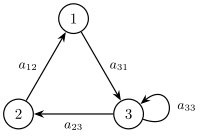
-
has the edges , ,
and the loop , drawn below. The values of the entries play
no part in the graph.
Non-example by minimal change. The
graph records whether an entry is zero, not how large it
is. Change the entry of the last matrix to
: the graph
is unchanged. Change it to : the edge disappears, and
with it every walk out of vertex other than the one of
length .
The graph was built to count routes, and it does, for
non-negative matrices. The same lemma handles , whose graph is
that of with a
loop added at every vertex; a loop lets a walk wait, so
walks of length at most become walks of length
exactly .
Lemma
19.2.1 (Powers Count Walks)
Let be non-negative, and let and .
- (a) if
and only if
has a walk of length from to .
- (b) if and only if has a walk of
length at most from to .
Idea. Induction on , peeling off the first
step of a walk. Expanding gives a sum of non-negative
terms, so it is positive exactly when one term is: a
first step
followed by a walk of length from to . For the diagonal
adds the option
of waiting at
instead of stepping.
Proof.
(a) Induction on
. For , exactly
when , which
is exactly when there is a walk of length from to . Suppose (a) holds for
. By Lemma 19.1.1 (c),
, so
is a sum of non-negative terms. It is positive
if and only if some term is, that is, if and only if
there is an with
and
. By the definition of and the induction
hypothesis, this says: there is an edge and a walk of
length from to . Putting in front of that walk
gives a walk of length from
to , and every
such walk arises this way, with its second
vertex.
(b) Induction on
, with the same
base case, since . Suppose (b) holds for . As and
,
is positive if and only if there is an with and either or . By the induction hypothesis this says: there
is a walk of length at most from to , where either or is an edge. In
the first case we have a walk of length at most from to ; in the second, putting
in front gives
one of length at most . Conversely, let a walk of length from to be given. If , take . If , take
to be its second
vertex, so that is an edge and the rest of the walk has
length . This
proves the lemma.
For the matrix drawn above, . Its entry is , and indeed the
shortest walk from back to is , of
length . Its entry is , from the walk .
A long walk can always be shortened to a path, and a
path is short.
Lemma
19.2.2 (Shortening a Walk to a Path)
Let . If has a walk from
to , then it has a path
from to , and every path has
length at most .
Idea. Take a shortest walk. If it
visited some vertex twice, the loop between the two
visits could be cut out, leaving a shorter walk; so a
shortest walk is a path. A path visits distinct
vertices, and there are only of them.
Proof. Among the walks from to , choose one of least
length (Theorem 0.2.11), say
. Suppose two of its vertices coincide, with . Deleting
leaves the list , which is still a
walk, because the edge (if ) is the edge . It has
length , contradicting the choice of . So the vertices are
distinct, and the walk is a path. A path of length has distinct vertices
among the
vertices of ,
so .
Strong
connectivity
Positivity of
says every vertex has an edge to every vertex. The
useful weakening is to ask only for a
walk.
A graph is strongly connected when every vertex
can be reached from every vertex.
Definition
19.2.2 (Strongly Connected)
Let . The graph is strongly
connected if, for every
ordered pair
of vertices, there is a walk from to .
In words: whichever vertex we start from, every
vertex can be reached, and the pair is
ordered, so a walk from to and a walk from back to are both required. By
Lemma 19.2.2, the
walks may be taken to be paths of length at most . For the walk of length
suffices, so the
graph of every matrix, included, is strongly
connected.
The cycle
above is strongly connected: from any vertex, follow the
arrows round. So is the graph drawn above, since it
contains the cycle , and so is the graph of every
positive matrix. The path is not: there is no walk from
to . Removing one edge from
the cycle, by changing to , gives exactly the
path, so the clause that fails is the one for the pair
; the walks
from to , from to and from to survive.
Irreducible matrices
Now the notion this chapter is built on. We want to
single out the matrices whose eigenvalue problem cannot
be split into two smaller ones. For a matrix with a zero
block in the lower left, it can: by Theorem 7.8.4 applied
to , and
the subspace spanned by the first few standard basis
vectors is mapped into itself. For such a matrix
Perron’s conclusions fail in general: and are of this
shape. In this chapter a change of basis must preserve
non-negativity, and the ones that do so while keeping
the entries themselves are the relabelings of the
coordinates. So the definition asks whether a relabeling
produces the zero block.
A matrix is irreducible if no relabeling of the
coordinates puts it in block upper triangular
form.
Definition
19.2.3 (Irreducible Matrix)
Let .
- (a) For , is
reducible if there are a permutation
matrix and an
integer with
such that with
the zero matrix. It is
irreducible if it is
not reducible.
- (b) For ,
every matrix is
irreducible, including .
In words: by Lemma 3.4.7 (b),
, so
is
similar to . It
is the matrix of in the standard
basis taken in another order, and in (a) we ask whether
some order has a zero block below the diagonal with
both diagonal blocks non-empty, which
is what says. Irreducible means that
no order does. Clause (b) is a
convention, justified below.
To see what relabeling does to the entries, we
compute it once.
Lemma
19.2.3 (Relabeling the Coordinates)
Let and . Then for all . Consequently is an edge of
if and only if is an edge of .
Proof. By Definition 3.4.2,
. The entry of a matrix
is , so by Theorem 0.9.5, The statement about edges is the statement
that one of these entries is non-zero exactly when the
other is.
So the graph of
is with the
vertex
renamed . In
particular, Definition 19.2.2
holds for one exactly when it holds for the other. The
zero block of Definition 19.2.3
becomes a statement about a set of vertices that no edge
leaves.
Lemma
19.2.4 (Reducible Means a Set of Vertices With
No Exit)
Let and
. Then
is reducible if
and only if there is a set with and
such that that is, such that no edge of goes from a vertex
in to a vertex
outside .
Idea. The zero block of Definition 19.2.3 sits
in the columns of the first relabeled vertices and
the rows of the others. So take to be the first vertices in the new
order; conversely, given , choose the order that
lists first. Lemma 19.2.3
translates between the entries and the vertices.
Proof. Let be the number of
elements of , so
,
and choose listing the elements of first: are the elements of and the others. For we have
and
,
so by Lemma 19.2.3, . That is, the
lower-left block of
is zero, and is
reducible.
Let and be as in Definition 19.2.3 (a).
By Definition 3.4.2,
for
some . Put , which has
elements, so it
is neither empty nor everything. If and , then with and with , and because
lies in the
zero block.
The condition says that the coordinate subspace
is mapped into itself by , since column of is and its entries
outside vanish.
So a reducible matrix is one with an invariant subspace
spanned by some of the standard basis vectors, other
than and
, and Theorem 9.1.3 is the
source of the block form.
Now some examples, simplest first.
- . Irreducible by (b).
- Positive matrices are irreducible:
no entry is , so
no set as in Lemma 19.2.4
exists.
- The swap is irreducible. For , the candidates are
, which
needs ,
and ,
which needs ; both entries are . So a matrix may have
zeros, even mostly zeros, and be irreducible.
- Triangular matrices with are reducible. An
upper triangular one already has the block form with
and . A lower triangular
one, such as the path matrix, is reducible too, by Lemma 19.2.4 with
: column
has its only
possible non-zero entry on the diagonal. Reversing the
order of the coordinates, ,
turns the path matrix into , which is upper
triangular.
- The zero matrix of size is reducible, and
so is : any
will do.
Non-example by minimal change. The
cycle is
irreducible, as the next theorem will show. Change its
entry from
to : the result is the path
matrix, and now has no exit, because the only
non-zero entry of column outside row , the entry , has become . That single clause of
Lemma 19.2.4 is what
changed.
Example
(A reducible matrix that does not look it)
Decide whether is
irreducible, and if not, put it in block triangular
form.
Solution. Column has its only non-zero
entry in row , so
has no
exit: . By Lemma 19.2.4, is reducible.
Following the proof, list first: , , . By Lemma 19.2.3, the
entry of
is ,
so Hence , and the eigenvalues are
and . In the
graph, vertex has
only a loop leaving it: a chain that reaches state stays there.
Why this definition, and why every matrix is
irreducible. The block form is the matrix
picture of an invariant coordinate subspace, and it is
exactly what splits into two factors
and lets the conclusions of Perron’s theorem fail, as
shows. For
there is no
room for two non-empty blocks, and a convention is
needed. Some books call reducible. We call
every
matrix irreducible because that is the choice that makes
the two theorems below true with no exception: the graph
of a
matrix is always strongly connected, through the walk of
length , and is always positive. The price is paid in
§03: the irreducible matrix has spectral radius
, so the statement
there that an irreducible non-negative matrix has carries
the hypothesis .
Warning. Irreducibility
depends only on which entries are zero, never on their
size. For every , however small, is irreducible, and
for its
eigenvalues are distinct, with the positive eigenvector
for
. At
it is lower
triangular, hence reducible, and becomes a double
eigenvalue with the eigenvector only. An entry of
and an
entry of
count the same; an entry of is different in kind.
The property is not preserved by powers either: the swap
is irreducible and its square is , which is not.
The first theorem says that irreducibility, defined
through relabelings, is exactly strong connectivity of
the graph.
Theorem
19.2.5 (Irreducible If and Only If Strongly
Connected)
Let and
. Then
is irreducible
if and only if is strongly
connected.
Idea. Both sides are about a set of
vertices with no exit. If some vertex cannot be reached from
, the set of
vertices that can be reached from contains , misses , and has no exit, since
an exit would reach one more vertex. Conversely, a set
with no exit traps every walk that starts inside it.
Proof. If , both sides hold,
by Definition 19.2.3 (b)
and the walk of length . Let . By Lemma 19.2.4 it
suffices to show: fails to be
strongly connected if and only if there is a set , neither empty nor all
of ,
from which no edge leaves.
Suppose there are
and with no walk
from to . Let be the set of vertices
such that there
is a walk from to
. Then , by the walk of
length , and . If and is an edge, then
appending to a
walk from to
gives a walk from
to , so . Hence no edge
leaves .
Suppose no edge leaves , and choose and . Let
be any walk from .
Then every lies
in , by induction
on : , and if
, the
edge does not leave , so . Hence no walk
from ends at
, and is not strongly
connected. This proves the theorem.
So the cycle
is irreducible, and so is the matrix drawn earlier:
their graphs are strongly connected. Deciding
irreducibility from the definition means looking at
relabelings;
deciding it from the graph means following arrows.
Quick check. Is irreducible? Every row and
every column of
contains a non-zero entry off the diagonal.
Solution. No. The edges of are , , and , so there is no
walk from to
, and is reducible by Theorem 19.2.5.
Directly, has no exit, and indeed is already block
diagonal, with and . Having an off-diagonal entry in every row
and column is necessary for irreducibility when (Exercise C1),
but it is not sufficient.
A test by
one matrix power
For a non-negative matrix, Lemma 19.2.1 turns
strong connectivity into positivity of a single matrix,
and that is the bridge back to Perron’s theorem.
Theorem
19.2.6 (Irreducibility Through a Power of )
Let and
let
be non-negative. Then is irreducible if and
only if
Idea. Read both sides as statements
about walks. Positivity of asks for
a walk of length at most between every
ordered pair of vertices, and strong connectivity asks
for a walk of any length. The two agree because a walk
can always be shortened to a path, and a path has at
most
edges.
Proof. By Lemma 19.2.1 (b),
if and only if, for every ordered pair , there is a walk
of length at most from
to . By Lemma 19.2.2, if there
is any walk from
to then there is
one of length at most , namely a path; so the condition is
equivalent to asking for a walk of any length from to , for every ordered
pair. That is Definition 19.2.2, and
by Theorem 19.2.5 it is
equivalent to irreducibility.
Both sides always hold for , as the convention
intends. The hypothesis cannot be dropped: is irreducible, but
adding cancels
its diagonal and leaves the swap, which is not positive.
Cancellation is exactly what non-negativity rules out,
since a sum of non-negative terms is zero only when
every term is.
Example
(The cycle, by one power)
For the cycle , compute
, and
compare with the powers .
Solution. is the permutation
matrix of , so and by Lemma 3.4.7 (a). As
and commute, so is
irreducible by Theorem 19.2.6, as the
graph already showed. On the other hand every power
is , or , each with six zero
entries, so no power of is positive. In the
graph, the walks from have lengths forced
modulo by where
they end. The loops of let a walk wait, which is what alone cannot do. §05
returns to this difference; it is the difference between
irreducible and primitive.
The theorem is the reason irreducibility is enough
for most of Perron’s conclusions. If is irreducible,
then is positive, so Theorem 19.1.5 applies
to , and is a polynomial in
, so every
eigenvector of
is an eigenvector of . §03 turns this
observation into the Perron–Frobenius theorem.
A reducible matrix splits into two diagonal blocks,
and each block may be reducible again. Splitting until
nothing splits gives a normal form.
Idea. Strong induction on : if is irreducible there
is nothing to do, and otherwise one relabeling gives two
smaller diagonal blocks, which the induction hypothesis
puts in normal form. The only work is to check that the
two relabelings of the blocks combine into one
relabeling of ,
and block multiplication does that.
Proof.
(a) Strong
induction on (Theorem 0.2.10). If
is irreducible,
which includes the case , take and . Otherwise , and there are a permutation matrix and with
Both sizes are less than , so by the induction
hypothesis there are permutation matrices () and () such
that
and
are block upper triangular with square irreducible
diagonal blocks. The direct sum (Definition 8.1.2)
is the permutation matrix of the
permutation
with for and for , since its
columns are . By Proposition 8.1.2,
, and by Theorem 8.1.1,
This is block upper triangular, and its
diagonal blocks are those of followed by
those of , all square
and irreducible. With , which is a permutation matrix by Lemma 3.4.7 (a),
the left side is by Theorem 0.9.5. This
proves (a).
(b) by Lemma 3.4.7 (b), so
is
similar to , and
by Theorem 7.10.3. The
matrix is block upper triangular with
diagonal blocks . Applying Theorem 7.8.4 over
, as the
paragraph after it notes, to the first diagonal block
and the rest, and then to the rest by induction on , gives . The roots of a product, with
multiplicities, are those of the factors
together.
(c) By (b), , and the largest
modulus over a union is the largest of the largest
moduli. If , then by Lemma 19.2.3 the
entries of are entries of
, so they are
, and so are
those of each .
The diagonal blocks of the normal form correspond to
groups of vertices of that can all reach
one another. The first block is a group with no exit,
and each later block can send edges only to the blocks
before it. In a Markov chain the first block is
therefore a set of states that the chain, once inside,
never leaves; §06 uses exactly this. The blocks are
unique up to their order and up to relabeling within
each block, but we shall not need this and do not prove
it.
Solution. Read the edges column by
column. Column
gives and
; column
gives the loop
; column
gives and ; column gives and the loop
. So and reach each other, and
from them one can go to and then to , but never back. The
groups are ,
and . Vertex has no exit, so it
comes first; the edges from go only to and , so comes next; then . With ,
that is , , , , Lemma 19.2.3 gives
with diagonal blocks , and the swap , each irreducible. By Theorem 19.2.7 (b),
, so the eigenvalues are , and , the
spectral radius of the second block.
Exercises
A. Check your
understanding
Exercise
(A1)
- (a) Define the
directed graph , a walk, and strong
connectivity. Which way does the edge for point?
- (b) Define
irreducible, including the case , and state Theorem 19.2.6.
- (c) True or false: a
matrix with a zero entry is reducible. Justify your
answer.
- (d) True or false:
if is
irreducible, then so is . Justify your
answer.
- (e) True or false:
is irreducible
if and only if is. Justify your
answer.
- (f) True or false:
the zero
matrix is irreducible. Justify your answer.
Solution.
(a) has vertices and an edge
for each
,
pointing from the column index to the row index. A walk
of length from
to is a list
with each an edge. is strongly
connected if there is a walk from to for every ordered pair
.
(b) For , is reducible if
for some permutation matrix and square blocks
, of sizes and , ;
irreducible means not reducible. Every matrix is
irreducible. The theorem: a non-negative is
irreducible if and only if .
(c) False. The
swap has two
zero entries and is irreducible, since its graph is strongly
connected (Theorem 19.2.5).
(d) False. The
swap is irreducible and its square is reducible, being
triangular.
(e) True. is with every edge
reversed, since . Reversing a walk from to in gives a walk from
to in , so one graph is
strongly connected exactly when the other is, and Theorem 19.2.5
finishes.
(f) False. With
, the zero
matrix is already upper triangular, so it is reducible
with , . Only the zero matrix is
irreducible, and that by convention.
B. Practice
Exercise
(B1: Deciding irreducibility)
Determine which of the following matrices are
irreducible. Justify your answers, and for each
reducible one give a permutation matrix that puts it in
block upper triangular form.
- (a)
- (b)
- (c)
- (d)
Solution.
(a) The non-zero
entries give the edges , , : the cycle ,
which is strongly connected. Irreducible, by Theorem 19.2.5.
(b) Column has its only non-zero
entry in row , so
has no
exit, and the matrix is reducible by Lemma 19.2.4. With
,
,
, Lemma 19.2.3 gives
, which is even
triangular.
(c) The edges are
(from ), and (from ), (from ) and (from ). The walk
passes through every vertex and returns, so any vertex
reaches any other by following it. Irreducible.
(d) Columns and have zeros in rows
and , so has no exit:
reducible. With , .
The edge
goes into , which
is allowed; only edges out of are forbidden.
Exercise
(B2: One power decides)
For each matrix, compute and decide
whether is
irreducible. For the reducible one, read off from a set of
vertices with no exit.
- (a)
- (b)
Solution.
(a) , and multiplying out,
Hence
is irreducible by Theorem 19.2.6.
(b) , and which has zero entries, so is reducible. By Lemma 19.2.1 (b),
column of is positive
exactly in the rows reachable from . Column is positive in rows
only, so the
vertices reachable from form , and by the
proof of Theorem 19.2.5 no edge
leaves it. Indeed .
Exercise
(B3: Eigenvalues from the normal form)
Let . Put in reducible normal
form, and hence find its eigenvalues and .
Solution. The edges are , , (column ), the loop (column ), and , (column ). Vertex has no exit, and , reach each other. List
first: , , . By Lemma 19.2.3, The blocks and are irreducible,
the second because both its off-diagonal entries are
non-zero. By Theorem 19.2.7 (b),
, so the eigenvalues are and , and by
(c), , coming from the second block.
C. Going deeper
Exercise
(C1: A necessary condition that is not
sufficient)
- (a) Prove that if
and is
irreducible, then every row and every column of contains a non-zero
entry off the diagonal.
- (b) Show that the
converse fails for every even .
Solution.
(a) Suppose
column has no
non-zero entry off the diagonal: for all . Then has no exit,
and is neither
empty nor everything because , so is reducible by Lemma 19.2.4. Suppose
instead row has
for all
. Then has no exit, since the only entries with and are the
with ; again is reducible.
(b) Let with , and let be the direct sum of
copies of the
swap . Every
row and column has a off the diagonal. But
has no
exit, since column and column are zero outside rows
, so is reducible. The
Quick check is the case .
Exercise
(C2: The exponent is sharp)
Let and
let be the
cyclic permutation matrix with for
and .
- (a) Prove that is irreducible, but
that is not positive.
- (b) Prove that if
is
irreducible, then for every .
Solution.
(a) The non-zero
entries of are
for and
, so
the edges of are and , and there are no
others. Following them from any vertex visits every
vertex, so
is strongly connected and is irreducible (Theorem 19.2.5). Each
vertex has exactly one outgoing edge, so the only walk
from of length
is
. In particular the shortest walk from to has length , and there is no
walk of length at most from
to . By Lemma 19.2.1 (b),
.
(b) By Lemma 19.2.1 (b),
exactly when there is a walk of length at
most from to . For , a walk of
length at most is one of length at most , and such walks exist
for every pair by the proof of Theorem 19.2.6. Hence
.
Exercise
(C3: Irreducibility as growth of supports)
Let and
with . For
, call
the support of .
- (a) Prove that the
support of is the support of together with every
vertex for which
there is an edge with .
- (b) Prove that is irreducible if and
only if, for every with at least one zero entry and at least
one positive entry, has more positive entries than .
- (c) Deduce, without
using walks, that for every non-zero when is irreducible, and
hence that .
Hint for (b): use Lemma 19.2.4.
Solution.
(a) is a sum of non-negative terms, so it
is positive if and only if or some , that
is, or
there is
with ,
which is an edge .
(b) Let be as stated, with
support , which is
neither empty nor everything. By (a), has support
containing , and
strictly larger exactly when some edge goes from to a vertex outside
. If is irreducible, Lemma 19.2.4 says
every such has an
exit, so the support grows. If were reducible, take
with no exit from
Lemma 19.2.4, and let
have entry on and elsewhere. Then has support
exactly , with the
same number of positive entries, contradicting the
hypothesis.
(c) Let , , and put . By (a) the supports never shrink, and by
(b) the support grows by at least one element at each
step until it is everything. It starts with at least one
element, so after at most steps it has , and then stays so:
.
Applying this to shows that column of is
positive, for every .