A Hermitian matrix carries two lists of real numbers: its
diagonal entries, read off at a glance, and its
eigenvalues, computed with effort. Since Chapter 9 we
have known that the two lists have the same sum, the
trace. This section asks what else the eigenvalues force
on the diagonal, and answers the question completely.
The answer needs a name, majorization.
One half of it, Schur’s theorem, is §06’s bound on
partial sums of the diagonal in the new language. The
other half, Horn’s theorem, says that nothing more is
forced; it is proved by an induction driven by a single
rotation. The section ends with a short second proof of
Hadamard’s determinant inequality.
Throughout, the field is or , and every matrix
whose eigenvalues are indexed is Hermitian,
with its eigenvalues real and listed
decreasingly with multiplicity, . Two vectors in are attached to
such an : 𝛌 The first is the diagonal
vector, in the order the entries sit on the
diagonal; the second is the eigenvalue
vector, always in decreasing order. The
diagonal entries are real because gives ,
and the eigenvalues are real by Theorem 12.2.1.
The bold is
a vector, not the diagonal matrix .
Two facts about a Hermitian are used below. The
spectral theorem (Corollary 12.4.3
over , Corollary 12.5.2
over ) makes
similar to the
real diagonal matrix of its eigenvalues, so its
characteristic polynomial splits as . Then Theorem 9.3.3 gives
What the
diagonal already knows
Start with the smallest interesting case. The matrix
has and eigenvalues and , with eigenvectors
and , so 𝛌.
The totals agree, . But the two lists are not alike: the
diagonal is perfectly even, while the spectrum is spread
out.
A larger example shows the pattern better. The
tridiagonal matrix has eigenvectors , and , with
eigenvalues ,
and . To check the first,
; the other two are
checked the same way. So 𝛌,
while . Sort the diagonal decreasingly to and compare the
running totals of the two lists: Each running total of the eigenvalues is at
least the matching running total of the diagonal, and at
the two are
equal. None of this is new. Corollary 17.6.3 says
that any diagonal
entries add up to at most , with equality at , and the largest diagonal
entries are one such choice. What is new is the point of
view: to ask which diagonals are
possible, the corollary’s list of
inequalities has to be read as a single relation between
two vectors.
Two features of this comparison deserve notice.
First, the diagonal had to be sorted,
and this is forced. For a permutation matrix (Definition 3.4.2),
by Lemma 3.4.7 (b), so
is Hermitian with the same eigenvalues as , and its entry is . Relabeling the basis
shuffles the diagonal and fixes the spectrum, so any
true relation between and 𝛌 must ignore
the order of the diagonal. Second, the comparison is
between running totals from the top,
and it measures how unevenly a fixed total is
spread.
Majorization
One vector is majorized by another when the two
have the same total but the second piles more of it onto
its largest entries: every “top ” sum of the second is
at least that of the first.
The sorting step gets a notation first. For , the decreasing
rearrangement is
the vector with the same entries, repeated as often as
in , listed so
that . For example, . In this notation, 𝛌𝛌 by convention, while
usually
needs sorting.
Definition
17.8.1 (Majorization)
Let and
let be real vectors with the
same number of entries. We say that
is
majorized by , and write , if
- (M1) for every
;
and
- (M2) (equal
totals).
We say that
is weakly majorized by , and write , if the
inequality in (M1) holds for every
,
including ,
and (M2) is dropped.
In words, clause by clause. (M1) sorts both vectors
and compares their running totals from the
top: the largest entry of is at most the largest
entry of , the
two largest of
add up to at most the two largest of , and so on up to . The word
every matters: one failing refutes . (M2) says
the totals are equal; a sum does not care about order,
so no sorting is needed there. Weak majorization keeps
(M1), adds its case , which reads , and asks nothing more. Comparing the
definitions: holds exactly when and the
totals are equal.
There is an equivalent way to read (M1) from the
bottom. Subtracting the -th running total from
the equal totals of (M2) gives so under (M2), the
smallest entries of add up to at least the
smallest
entries of . The
vector is more
extreme at both ends: its top is heavier and its bottom
is lighter.
The definition makes sense because is
determined by :
when two entries are equal, it does not matter which is
written first. A consequence worth recording:
the relation sees only which numbers occur in
each vector and how often, not where they sit.
If is a
rearrangement of
and of
, then if and only
if , because the rearrangements have the
same decreasing rearrangements and the same totals.
Example
(A chain, the two extremes, and size one)
Check each claim against Definition 17.8.1.
- (a) .
- (b) For every with mean
, the flat vector
satisfies .
- (c) For every with
non-negative entries and total , .
- (d) For , if and only
if .
Solution.
(a) All three
vectors are already decreasing, and all have total , so (M2) holds for both
pairs. Their running totals are At
and the first
row is at most the second (, ), and the second is at most the third (, ). So (M1) holds
for both pairs.
(b) The totals
are , so (M2) holds. For (M1), fix and let be the average of the largest entries. Each
of these is at least , so
. Every remaining entry with
is at most
,
hence at most .
Therefore so , and multiplying by gives . The left side is the -th running total of
. This is
(M1).
(c) The totals
are both . Every
running total of equals , and because the omitted entries are . This is (M1).
Non-negativity is really needed: has total , but
fails at ,
since .
(d) For there are no values
of in (M1), since
runs from to . So only (M2) remains,
and it says .
Parts (b) and (c) are the two ends of the order:
among vectors with a given total, the flat vector is the
most evenly spread, and among non-negative ones, the
vector that puts everything in one entry is the least.
Part (d) is the degenerate case: with a single entry
there is nothing to spread, and the relation collapses
to equality.
The chain in (a) might suggest that any two vectors
with the same total can be ranked this way. They
cannot.
Example
(Neither majorizes the other)
Show that and have the same total, that neither nor , and that
both are majorized by .
Solution. Both totals are , and both vectors are
already decreasing. Their running totals are At ,
, so (M1)
fails for . At , , so (M1) fails for . The vector
has total
and running
totals ,
which are at least both and
at . So
and .
This is the non-example by minimal change. Start from
the comparable pair , move one unit in the second
vector from its top entry to its middle entry to get
, and the
pair becomes incomparable. (M2) still holds; what fails
is (M1), at a different in each direction.
Spreading is not a single number.
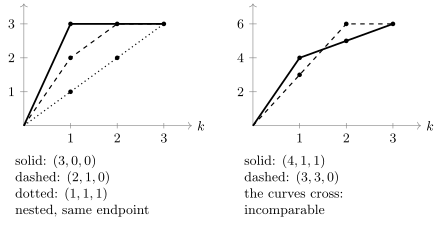
The picture makes this visible. Plot the running
totals of a sorted vector against , joined by segments,
starting from . Then says that the curve of lies on or above the
curve of and
ends at the same height. Two curves can also cross.
Why this definition. Each clause
earns its place, and changing any one of them changes
the subject.
- Sorting. Relabeling a basis shuffles and fixes 𝛌, so a
relation comparing unsorted entries would answer a
question the matrix does not pose.
- Running totals from the top, with . These are the
quantities that Theorem 17.6.2 and Corollary 17.6.3
control: the top
eigenvalues sum to a maximum. Totals from the bottom add
nothing new, as shown above, because under (M2) they are
the same information.
- Equal totals. This is the trace. Dropping
it gives weak majorization, the right notion when there
is no conservation law to enforce: ,
but , because the totals differ.
Warning. does not mean
, not
even after sorting both vectors. In , the third entries are and , and . This is no
accident: subtracting (M1) at from (M2) gives
whenever , so at the
bottom the inequality always runs the other way.
Majorization compares sums of the largest
entries, not entries one at a time.
Quick check. Arrange the five
vectors , , , and in a chain .
Solution. All five are decreasing
and all have total . Their running totals
at are
Read in this order, each triple is entrywise
at most the next, so The ends are the flat vector and the
concentrated vector of Example (A chain, the two extremes, and size one)
(b) and (c), as they must be. These five happen to be
comparable in pairs, but Example (Neither majorizes the other)
shows that this is not always so.
Majorization is an order
The first small result is that behaves like an
order, and it says precisely how it falls short of being
a partial order on .
Proposition
17.8.1 (Basic Properties of
Majorization)
Let .
- (a) .
- (b) If and , then .
- (c) If and , then ; that is, is a rearrangement of
.
Statements (a) and (b) hold with in place of .
Proof. For , write
, and define and in the same way.
Since , Definition 17.8.1 says
that
means
for and
.
(a) for every
, and .
(b) For , . At
, . Hence
.
(c) The
hypotheses give and for , and , so for every . Put . Then for
each , so . Two vectors with the same
decreasing rearrangement contain the same numbers, each
the same number of times, so each is a rearrangement of
the other.
For , the
arguments for (a) and (b) are the same with every treated like
. This
proves the proposition.
So is
reflexive and transitive. A relation with these two
properties is called a preorder. Part
(c) is antisymmetry up to rearrangement, and no more:
, yet . So is
not a partial order on . Restricted to
decreasing vectors, where a
rearrangement is the vector itself, (c) is exact
antisymmetry, and there is a partial order.
By Example (Neither majorizes the other)
it is not total, not even among
non-negative decreasing vectors with the same total.
Like the Loewner order of Chapter 13 (Proposition 13.5.1),
it leaves many pairs uncompared.
Schur’s
theorem
The running totals in the example were
not a coincidence. Restated in the language of
majorization, §06’s Corollary 17.6.3 says
that for every Hermitian matrix the diagonal is more
evenly spread than the spectrum:
Theorem
17.8.2 (Schur’s Majorization Theorem)
Let or
, and let
be
Hermitian. Then 𝛌 Explicitly, if
lists the diagonal entries of decreasingly, then
Proof. Both vectors lie in , as noted at the
start of the section. Fix with . List the
positions in an order in which the diagonal entries
decrease, breaking ties arbitrarily, and let
be the first
positions of that list, written in increasing order.
Then are in some order, so Corollary 17.6.3 gives
with equality when . For this is (M1).
For it is
(M2), since a sum does not depend on the order of its
terms. This proves the theorem.
So Schur’s theorem is Corollary 17.6.3
restated. What the restatement adds is a relation
between two vectors, and a relation has a converse that
can be asked about. Read from the bottom, (M1) says that
the smallest
diagonal entries add up to at least the
smallest
eigenvalues. At the two ends of Example (A chain, the two extremes, and size one),
a diagonal matrix has a rearrangement of
𝛌, the
most spread a diagonal can be; a
constant diagonal is the flat vector
, where Schur’s
theorem says only that .
Example
(Coordinate vectors against eigenvectors)
For the matrix from the start of the section, whose running
totals were tabulated there, exhibit for the coordinate pair
that the proof of Corollary 17.6.3 feeds
to Theorem 17.6.2 and an
orthonormal pair that attains the maximum in Theorem 17.6.2.
Account for the difference between the two sums.
Solution. We found 𝛌,
with unit eigenvectors , and . They are pairwise
orthogonal (for instance ), and each vector in parentheses has
length .
For the
proof uses the two largest diagonal entries, and , so the
coordinate pair is , and . The pair gives , since . The
coordinate pair falls short of the eigenvector pair by
, and that
shortfall is exactly the slack in Schur’s theorem at
. Ky Fan’s
maximum is attained by eigenvectors, and the diagonal
only ever sees coordinate vectors.
Quick check. A Hermitian matrix has diagonal entries
. Without
knowing anything else about , what does Theorem 17.8.2 say
about , about
, and about ?
Solution. Sorted, , with running totals . So ,
, and . Subtracting the middle
inequality from the last equality gives . In particular is indefinite, since
, and that was visible without
computing any eigenvalue.
Horn’s
converse
Schur’s theorem gives a necessary
condition on a diagonal. Is it also sufficient? Given
𝛌,
is there a Hermitian matrix with eigenvalues and diagonal entries , in the
given order? For a rotation answers the question. Turning the
eigenbasis of moves its first diagonal entry
through every value between and , and the trace
fixes the second entry.
Lemma
17.8.3 (The Two-by-Two Rotation)
Let and be real numbers with
. Put . Then
there is an orthogonal with
Idea. If the first row of is with , the entry of is , an average of and with weights
and . Every between them is such an
average, and solving for the weights gives and .
Proof. If ,
then and , and works. Otherwise , and are real numbers, because both radicands are
by the
hypothesis on .
They satisfy . Let . Then , so . Multiplying out, Since , the entry is .
The two diagonal entries add up to , so the entry is . Finally . This
proves the lemma.
This is the converse for : if
and , then by (M1), so by (M2) , so is allowed. For larger , the lemma is used
once, on a well-chosen pair of eigenvalues, to put in the corner, and
induction does the rest.
Theorem
17.8.4 (Horn’s Theorem)
Let , and
let and 𝛌 be vectors in
with 𝛌. Then
there is an orthogonal such that the matrix has diagonal entries ,
in this order. So is a real symmetric
matrix with and 𝛌𝛌.
Idea. Induction on , one diagonal entry at
a time.
① Permutation matrices are orthogonal and shuffle
diagonal entries, so it is enough to treat and 𝛌 both decreasing.
② The top and bottom clauses of majorization put between and , hence between
two consecutive eigenvalues, . The lemma rotates that pair so
that sits in
the corner, with next to it. ③
The Claim: what is left over, the diagonal and the
spectrum with replaced by , satisfies the
hypothesis again, in size . ④ Induction rotates the lower block
into place without touching the corner.
Step ③ is where the choice of matters.
Proof. For every , the
matrix is
real and symmetric, and by Corollary 12.5.2
its eigenvalues, with multiplicity, are ; listed decreasingly they form 𝛌. So
only the diagonal needs work. We use two facts
repeatedly. A product of orthogonal matrices is
orthogonal, since . And for a permutation and any , Definition 3.4.2
gives where is orthogonal by
Lemma 3.4.7
(b).
Step 1: reduction to decreasing
vectors. Suppose the theorem holds whenever
and 𝛌 are both
decreasing, and let 𝛌 be arbitrary. Majorization sees only
rearrangements (as noted after Definition 17.8.1), so
𝛌, and there is such
that 𝛌 has
diagonal . Here
𝛌
is the diagonal matrix with diagonal . Since 𝛌 is
a rearrangement of 𝛌, and of , there are
permutations with and for all . By , 𝛌, and the entry of is
. So is orthogonal and
𝛌 has diagonal . It therefore suffices
to prove the theorem for decreasing and 𝛌, and we do so by
induction on .
Step 2: the corner. For , 𝛌 means
(Example (A chain, the two extremes, and size one)
(d)), and
works. Let ,
assume the theorem for (for vectors in any order, by Step 1), and
let and 𝛌 be decreasing
with 𝛌. By (M1) at , .
Subtracting (M1) at from (M2) gives , so
. Let be the smallest index
in with ;
one exists, since . Then : for
this is , and
for the
minimality of
gives . So By Lemma 17.8.3 with
, there are
and
a real with Moreover , since and .
Step 3: the leftover data. Put 𝛌 two vectors in . So 𝛌 is 𝛌 with the pair
replaced by the single number
, written
first.
Claim. 𝛌.
Proof. By Step 2, , for
those of these indices that exist. So is 𝛌,
and is
already decreasing. For (M2), , by (M2) for 𝛌 and the
definition of .
For (M1), fix
with ; when there is nothing to check.
Case . Then for . For each such , , because and 𝛌 are decreasing
and .
Summing over gives .
Case . The first entries of 𝛌
are , then , then . So Since , (M1) for 𝛌 applies at and gives In both cases (M1) holds, which proves the
claim.
Step 4: assembly. Let list the
indices
first and the others after them in increasing order:
,
,
and are . By , where ; when the blocks
involving are
absent. Let . Multiplying blocks and
using Step 2, where is the first
standard basis vector of and
is the diagonal matrix of 𝛌. By the
Claim and the inductive hypothesis, there is such
that has
diagonal entries . Let . Then whose diagonal entries are . The
block matrices
and are
orthogonal, since and are block
diagonal with blocks , ,
and , . So
is orthogonal, and . This completes
the induction and proves the theorem.
Over nothing
more is needed, because an orthogonal matrix is unitary
and a real symmetric matrix is Hermitian. Together with
Schur’s theorem, this settles the question the section
began with.
Theorem
17.8.5 (Schur–Horn Theorem)
Let or
, and let
𝛌. There is a Hermitian with 𝛌𝛌 and if and only
if 𝛌. In words: the diagonals of the
Hermitian matrices with spectrum 𝛌 are
exactly the vectors majorized by 𝛌, and real
symmetric matrices already give all of them.
Proof. By Theorem 17.8.2, 𝛌𝛌. Since majorization sees
only rearrangements, 𝛌.
Theorem 17.8.4 gives a
real symmetric with and 𝛌𝛌, and a real symmetric
matrix is Hermitian.
Example
(Building a matrix from its diagonal and
spectrum)
Find a real symmetric matrix with eigenvalues and diagonal
.
Solution. Both vectors are
decreasing, and : the running totals are against , and both totals are
. Follow the proof
of Theorem 17.8.4.
The corner. lies between and , so , , and
Lemma 17.8.3 gives
. After the first rotation the matrix is
The leftover. and
𝛌, with and , so 𝛌, as the Claim promises. The lemma
with gives
,
, and
Assembly. The first row becomes , so Check directly: , , and . Three eigenvectors with distinct
eigenvalues
give the whole spectrum, and the diagonal is .
Hadamard’s
inequality from the diagonal
Chapter 13 §06 proved Theorem 13.6.4: for a
positive semidefinite , , with equality if and only if is diagonal or some
. That
proof inducts on the size through Fischer’s inequality
(Corollary 13.6.3). A
much shorter route scales so that its diagonal
is flat, and then compares the product of the
eigenvalues with their sum. That comparison is the
inequality between the arithmetic and geometric means,
which the book has not yet proved; it is pure algebra,
and it comes first.
Lemma
17.8.6 (The Arithmetic–Geometric Mean
Inequality)
Let and
let
be non-negative real numbers. Then
with equality if and only if .
Idea. Scale so that the mean is
. If the numbers
are not all , one
of them lies above and another below.
Merge that pair into the single number . This
leaves
non-negative numbers with mean , so induction applies
to them. The merge can only increase the product,
because and both factors are positive. So the original
product is at most, and when it is non-zero strictly
less than, a product that induction bounds by .
Proof. Step 1: mean . We prove by
induction on : if and , then , with
equality only when every . For the hypothesis says , and the product
is .
Let and
assume the claim for numbers. If every , the product is
. Otherwise some
: if
every
with at least one strictly smaller, the sum would be
less than .
Similarly some , since if every with at least
one strictly larger, the sum would exceed . Then . Neither the sum
nor the product depends on the order of the numbers, so
we may relabel so that and . Put Then , since and . The numbers are non-negative and add up
to . So by the
inductive hypothesis , where (with when ). Moreover If ,
then . If , then . In either
case the product is strictly less than when the are not all . This completes the
induction.
Step 2: the general case. Let . If , then every , since non-negative numbers with sum are all . Both sides are then
, and the are all equal. If
, the
numbers are
non-negative with sum . By Step 1, with equality if and only if every , that is, every
. Numbers
that are all equal to some have mean , so “every ” is the same as
“all the are
equal”. This proves the lemma.
In the language of this section, the lemma says that
among non-negative vectors with a fixed total, the
flat vector, which is the bottom of the
majorization order (Example (A chain, the two extremes, and size one)
(b)), has the largest product.
Corollary
17.8.7 (Hadamard’s Inequality, Second
Proof)
Let or
, and let
with
. Then
with equality if and only if is diagonal or some
.
This is Theorem 13.6.4 (a)
again, with the same hypothesis and the same equality
condition. What is new is the proof.
Idea. Suppose first that every
diagonal entry equals . Then , so the
eigenvalues, which are non-negative, add up to , and Lemma 17.8.6 gives
. A general
diagonal is made flat by a diagonal congruence with
. This congruence
preserves positivity and divides both sides of the
inequality by the same number . Zero
diagonal entries, where does not exist, are
handled first and separately.
Proof. Each by Definition 13.1.1, and
each by Theorem 13.1.4
(b).
Case 1: some . The right-hand side is . Suppose . By Theorem 9.3.3, , so every is
non-zero, hence positive. By Theorem 13.1.5 (b),
, so
, a contradiction.
Hence ,
and the inequality holds with equality, as the statement
says it should when some .
Case 2: every . Let , a
real diagonal matrix with non-zero diagonal, so and is invertible. Put
. By Proposition 13.1.2
(a), .
Its entries are , so for every
, and . By Theorem 9.3.3, The are
non-negative by Theorem 13.1.4 (b). So
Lemma 17.8.6 and Theorem 9.3.3 give
with equality if and only if all are equal,
hence all equal to . By Theorem 7.5.4, and
since , Multiplying by the positive number gives
.
For equality in Case 2: equality holds exactly when
every . If so, the spectral theorem (Corollary 12.4.3,
or Corollary 12.5.2
over ) gives
for some unitary (or orthogonal) . Then is diagonal.
Conversely, if
is diagonal, then , and every . So in
Case 2, equality holds if and only if is diagonal. Together
with Case 1, this is the stated equality condition. This
proves the corollary.
For the matrix of Example (Coordinate vectors against eigenvectors),
which is positive definite since its eigenvalues are
, the
inequality reads .
The two proofs show different things. The first
proves more along the way: Fischer’s inequality for
blocks of any sizes. The second shows that once the
diagonal is scaled flat, the trace and the
arithmetic–geometric mean inequality suffice. Of 𝛌
it uses only clause (M2), which for a matrix is just the
trace.
Majorization is the language this chapter’s
eigenvalue inequalities were already using, and the
Schur–Horn theorem shows that it fits the diagonal
problem exactly. The same language compresses the
inequality of Section 7 for arbitrary index sets, Theorem 17.7.2, into
one line. The
largest entries of the vector 𝛌𝛌 add up to the largest value of
over index sets of size
, and the totals
are . So a bound of every such sum by says exactly that 𝛌𝛌𝛌 The diagonal of a Hermitian matrix and the
eigenvalues of a difference are both controlled by one
ordering of vectors in .
Exercises
A. Check your
understanding
Exercise
(A1)
- (a) State the
definitions of and for .
- (b) Decide whether
, and whether .
- (c) True or false:
if ,
then .
Justify your answer.
- (d) State Theorem 17.8.2. Which
result of §06 is it a restatement of?
- (e) State Theorem 17.8.5. Which
half is proved by induction on , and which lemma does
each step of that induction use?
Solution.
(a) means that
for every , and
(Definition 17.8.1).
means
that the same inequality holds for every , with no
condition on the totals.
(b) Both vectors
are decreasing with total . Their running totals
at are
and . Since and , . The reverse fails at , since .
(c) False. The
definition compares sorted vectors, so
the unsorted first entries can go either way. Take and . Both have
decreasing rearrangement , so (M1) at reads , and both totals are ; hence . But .
What is true is , which is (M1) at .
(d) For a
Hermitian , or , 𝛌. It restates Corollary 17.6.3:
applied to the positions of the largest diagonal
entries, the corollary gives (M1), and its equality at
gives
(M2).
(e) For 𝛌,
there is a Hermitian matrix over or with diagonal , in the given order,
and eigenvalues if and only if 𝛌. The
half “𝛌 implies such a matrix exists” is
Horn’s theorem, Theorem 17.8.4, proved
by induction on .
Each step uses Lemma 17.8.3, applied
to a pair of consecutive eigenvalues , to put in the corner. The
other half is Schur’s theorem.
B. Practice
Exercise
(B1: Determine which pairs are comparable)
For each pair, determine whether and whether
.
Where a relation fails, name the exact clause and the
value of at which
it fails. Justify your answer.
- (a) , .
- (b) , .
- (c) , .
- (d) , .
- (e) , ; decide
also whether .
Solution. In each case, sort first,
then compare running totals.
(a) Both are
decreasing with total . Running totals: and . Every entry
of the first list is at most the matching entry of the
second, so and hence .
(b) with running totals , and has running totals
. The totals
agree and ,
, so and . This is Example (A chain, the two extremes, and size one)
(c), applied after sorting.
(c) Running
totals and
. Every
inequality holds, including at , so . But the
totals are ,
so (M2) fails and .
(d) with running totals , and has running totals
. The totals
agree, but at , , so (M1) fails at . Neither
nor
holds.
(e) Both are
decreasing with total . Running totals: and . At , , so (M1)
fails at and , and also . For
, the
inequalities and hold, but at , so (M1) fails at . The pair
is incomparable, like Example (Neither majorizes the other).
Exercise
(B2: Schur’s theorem for one matrix)
Let
- (a) Verify that
, and are
eigenvectors of ,
and find 𝛌.
- (b) Write down and verify every
clause of 𝛌.
- (c) Hence verify
Hadamard’s inequality (Theorem 13.6.4) for
.
Solution.
(a) Multiply out:
Three distinct eigenvalues of a matrix account
for the whole spectrum, so 𝛌.
(b) , and
. (M1): at , ; at , . (M2): . Hence 𝛌, as Theorem 17.8.2
requires.
(c) All
eigenvalues are positive, so by Theorem 13.1.5 (b),
and Corollary 17.8.7
applies. By Theorem 9.3.3, , while . Hence . The inequality
is strict, as it must be, since is not diagonal and no
diagonal entry is .
Exercise
(B3: Which diagonals are ruled out?)
A Hermitian matrix has eigenvalues . For each
proposed list of diagonal entries, determine whether Theorem 17.8.2 rules
it out. Justify your answer.
- (a) .
- (b) .
- (c) .
- (d) .
- (e) .
For the lists that are not ruled out, what does Theorem 17.8.5
add?
Solution. Here 𝛌,
with running totals and total .
(a) Running
totals , total
. Since and , the list is
not ruled out.
(b) At , . Ruled
out. No diagonal entry can exceed .
(c) The total is
.
Ruled out by (M2): the trace would be
wrong.
(d) This is the
flat vector with total , which is majorized by
every vector with total (Example (A chain, the two extremes, and size one)
(b)). Not ruled out.
(e) Sorted, it is
, with
running totals
and total . At
, . Ruled
out. Independently,
contradicts the bottom-end inequality of the
warning.
Schur’s theorem is only a necessary condition, so for
(a) and (d) it shows only that nothing forbids these
diagonals. Theorem 17.8.5 adds
that they occur: for each of them there is a real
symmetric matrix with eigenvalues and that
diagonal.
C. Going deeper
Exercise
(C1: Majorization squeezes the range)
- (a) Prove that if
, then
.
- (b) Deduce that
every diagonal entry of a Hermitian lies in .
- (c) Show that the
conclusion of (b), together with equal totals, does
not imply majorization. Prove that no
Hermitian matrix has eigenvalues and diagonal
entries ,
although every one of these entries lies in and the totals
agree.
Solution.
(a) The
inequality is (M1) at (for , by Example (A chain, the two extremes, and size one)
(d), and there is nothing to prove). The middle
inequality holds because is
decreasing. For the left inequality, subtract (M1) at
from
(M2):
(b) By Theorem 17.8.2, 𝛌. Apply (a) with and 𝛌, using
𝛌𝛌. Every diagonal entry lies between
the smallest and the largest diagonal entry, which (a)
places between and . (This also
follows from Lemma 13.5.2 at . The point of
(a) is that it is a property of majorization
itself.)
(c) The vector
has
running totals , and has . At , , so , and by Theorem 17.8.2 no
Hermitian matrix has this diagonal and this spectrum.
Yet , and both totals are . The range condition
controls only the running totals at and , while
majorization constrains the middle ones too, which is
why the example needs .
Exercise
(C2: A weaker determinant bound)
Let with .
- (a) Prove that , with equality if and only if
for some
real .
- (b) Prove that . Deduce that
Hadamard’s inequality (Theorem 13.6.4) always
implies the bound in (a).
- (c) For whose eigenvectors are , and , compute the
three numbers , and
.
Solution.
(a) The
eigenvalues are
non-negative by Theorem 13.1.4 (b). By
Theorem 9.3.3 and Lemma 17.8.6, Equality holds if and only if all equal a
common value . By the spectral theorem this happens if and
only if . Conversely, gives equality directly.
(b) The are non-negative
(as in the proof of Corollary 17.8.7) and
add up to .
So Lemma 17.8.6 gives
. Combined with Corollary 17.8.7, this
gives , so the Hadamard
bound always sits between and the bound of
(a). The bound in (a) sees only the total of the
diagonal, while Hadamard’s bound sees each entry, and so
it is never worse.
(c) Check the
eigenvectors: ; ; . So 𝛌,
and .
Then and , with both inequalities strict.
Exercise
(C3: The possible diagonals form a convex set)
For
and ,
write .
- (a) Prove that .
- (b) Deduce that
for all .
- (c) Let 𝛌. Prove
that if 𝛌 and 𝛌,
then 𝛌 for every .
- (d) Hence show that
if and are Hermitian matrices with
the same eigenvalues, then for every there is a
real symmetric matrix with those eigenvalues and
diagonal .
Hint for (a): if are the entries , , in decreasing
order, count how many entries of are at least .
Solution.
(a) Let , and
list the entries , , decreasingly as
. For each , the entries sit at different positions of
and are all
. If , then, since is
decreasing, only could be , which is fewer
than entries.
Hence for every , and summing gives
. The bound is attained by the positions
of the largest
entries, chosen as in the proof of Theorem 17.8.2. This
proves (a).
(b) Let be a set of positions at which
attains the
maximum in (a). Applying (a) three times,
(c) Put . Its total is , by (M2) for both
hypotheses. For a scalar , multiplying by does not change the
order of the entries, so .
For , (b) and (M1) for both hypotheses give 𝛌𝛌𝛌 So 𝛌.
(d) Let 𝛌𝛌𝛌. By Theorem 17.8.2, 𝛌 and
𝛌. By (c), 𝛌. By Theorem 17.8.4 there
is a real symmetric matrix with eigenvalues 𝛌 and exactly this
diagonal. So among Hermitian matrices with a fixed
spectrum, the set of diagonals contains the segment
between any two of its points: it is
convex.