Chapter 11 measured vectors, and measured them in
exactly one way: . Every length in Chapters
11 to 13 came out of that formula. This section keeps
the measuring and throws the inner product away. The
reason is not economy. The quantities this part of the
book owes — how fast a sequence of matrices settles
down, how far a solution moves when the data moves — are
often measured most naturally by a size that no inner
product produces, and the arguments that use them turn
out to need only three properties of a length.
The field here is or , as it is
throughout the chapter. A length is a real number, and
the scaling rule below multiplies it by ; so the
scalars must carry an absolute value, and these are the
only fields in this book that do.
What
measurement actually needs
Look back at how was used
after Chapter 11 defined it. Cauchy–Schwarz needed the
inner product. So did Pythagoras, orthogonality and the
adjoint. But a long list of arguments did not: that a
convergent sequence is bounded, that is small when
is small, that a
limit of unit vectors is a unit vector, that . Every one of those used only
that
vanishes just for , that , and the triangle
inequality of Corollary 11.1.6.
Three properties, used over and over. Following the
book’s habit, we give the three of them a name and see
what else satisfies them.
A norm is a length: zero only at the zero vector,
scaling with the scalar, and never rewarding a
detour.
Definition
16.1.1 (Norm)
Let be or and let be a vector space
over . A
norm on is a function such that for all and
all :
- (N1) , and
only for (positive
definiteness);
- (N2) (absolute
homogeneity);
- (N3) (the triangle
inequality).
A vector space carrying a norm is a normed
space. A vector with is a
unit vector, and replacing a non-zero
by is
normalizing it.
In words, clause by clause. (N1) says the output is a
genuine non-negative size, and that only the zero vector
has size zero; the word only is the
whole content, since the reverse implication is free
(take in (N2)
to get ). (N2) says that stretching
a vector by
stretches its length by — the
absolute value of , so that
and, over ,
. (N3) says that going from to directly is at
most as long as going by way of . Note what the
definition does not mention: no second vector is paired
with the first, no angle appears, and there is no inner
product anywhere.
Two remarks on the shape of the definition. First,
the codomain is
even when :
a length is never complex. Second, the three clauses are
not independent of the arithmetic of — (N3) is an
inequality, and inequalities are why the field had to be
restricted.
Example
(The -, - and -norms on )
For put Check each of them against Definition 16.1.1.
Solution. (N1) holds for all three:
each is a sum, a square root of a sum, or a maximum of
the non-negative numbers , so each
is ; and each
vanishes only when every ,
that is, only for . (N2) holds because for every , and the common factor
comes out of a sum, out of a square root of a sum of
squares, and out of a maximum of non-negative numbers
alike.
For (N3), the -norm inherits it one
coordinate at a time: for each by the triangle
inequality for the modulus (Theorem 0.6.4, which
covers as
well), and summing over gives . The -norm inherits it
too, but from one coordinate rather than all: for each
, and a bound valid for every bounds the maximum. The
-norm is the norm
induced by the standard inner product on (Definition 11.1.3),
so its triangle inequality is Corollary 11.1.6
and needs no fresh argument.
So one space carries at least three different norms.
For they give , and
— three honest answers to “how big is ”, and no reason yet to
prefer one.
Example
(Inner products, weights, and a function space)
Three further families.
- (a) Every
inner product gives a norm. If is an inner product
space, then satisfies (N1) and (N2)
by Theorem 11.1.2 (a),
(b) and (N3) by Corollary 11.1.6.
In particular the Frobenius norm on and the
norm on are norms.
- (b) Weighted
norms. Fix real weights
and put . All three clauses
go through exactly as for , the
weights riding along untouched; positivity of every
is what (N1)
needs.
- (c) The sup
norm. On , the real
continuous functions on , put .
For (c) the maximum has to exist before the formula
defines anything, and that is the first place this
chapter borrows: is compact and
is
continuous, so by the extreme value theorem,
fact (A4) of the chapter introduction, the
maximum is attained. Granting that, (N1) says a
continuous function with is
the zero function, which is true pointwise; (N2) and
(N3) follow from the corresponding facts about at each
point, exactly as for on
. Note that
is
infinite-dimensional — it contains all the polynomials —
and it is kept in view deliberately, because §02’s main
theorem will fail on it.
A degenerate case is worth one line. On itself,
is a norm, and (N2) forces every norm on to be , a positive multiple of that
one. On the zero space the only function to is , and it is
a norm. Both matter: they say that the theory is not
empty at the bottom, and the first of them is the model
for the general statement that any two norms differ by
bounded factors.
Example
(Three near misses)
Change one feature of an example above and watch a
single clause break.
- (a) Drop the
square root. On put . Then (N1) still holds.
But , so (N2) fails as soon as :
for and
it gives
. The square root in is there
for exactly this reason.
- (b) Forget a
coordinate. On put .
Then (N2) and (N3) both hold, inherited from on
. What fails is
the word only in (N1): while . A function
satisfying (N1) with “only” deleted, together with (N2)
and (N3), is called a seminorm; it
measures a quotient of rather than .
- (c) Bend the
exponent the other way. On put . Then (N1) holds, and
(N2) holds because factors out of the inner sum and
is squared back to . Only (N3) fails: but
.
Item (c) is the one to remember, because it shows the
three clauses are genuinely independent: two of them can
hold exactly while the third fails, and it is the
failing one that carries all the geometry.
Warning. A norm is not
determined by what it does to the standard
basis. Both and give
every length
, and so does
, yet
the three disagree everywhere else: on they
return , and . Knowing the
lengths of a basis pins down nothing, and this is worth
holding on to, because §02’s theorem is sometimes
misremembered as saying that norms which agree on a
basis agree everywhere. It says no such thing.
One small consequence of (N3) will be used twice
below and again in §02, so it gets a name here. It is Exercise (B4: A lower bound for a difference of norms)
with the inner product removed from the proof.
Lemma
16.1.1 (Reverse Triangle Inequality)
Let
be a norm on .
Then for all ,
Proof. By (N3) applied to , we
have , so . Swapping the roles of and gives , and by (N2). The number is one of the two quantities
just bounded, so it is at most . This
proves the inequality.
Read with
replaced by , it says that the
function changes by
at most when its argument moves from to . That is a Lipschitz
estimate, and it is the reason a norm is continuous with
respect to itself — a fact §02 turns into the main
theorem.
Unit
balls
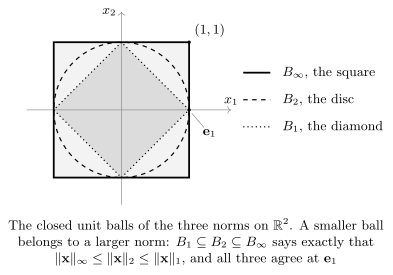
The quickest way to see the difference between two
norms is to draw the set of vectors they call short.
In the
three are a diamond, a disc and a square, and they are
nested.
Two features of the picture are general. Each ball is
symmetric, if and only if
, which is
(N2) with ;
and each is convex, since if and then by (N3) and (N2). The diamond has corners and
the square has corners; convexity is what the triangle
inequality buys, and it is all it buys. The disc is
rounder than the other two for a reason that is the
subject of the last part of this section.
The nesting in the picture is an inequality, and it
holds in every dimension, with a matching chain running
the other way.
Proposition
16.1.2 (Comparing the Three Norms)
For every , and Each of the four inequalities is attained: the
first two by , the last two by .
Idea. Four inequalities, two moves.
The ones without a compare a sum
against its largest term, or a sum of squares against
the square of a sum, and need nothing but
non-negativity. The ones with a are a trade of
terms against
one, and the sharp constant comes from Cauchy–Schwarz
against the all-ones vector — which is exactly why
is the vector
that attains them.
Proof. Write and let . Then ,
and taking non-negative square roots gives . Next, since every cross term is ; taking square
roots gives .
For the third inequality, apply Theorem 11.1.5 in
with the dot
product to the vectors and : For the fourth, , and taking square roots gives .
For the equality cases, has , and has , and
, so and . This proves the
proposition.
So the three norms never disagree by a factor worse
than , and
the factor
really occurs. Hold on to both halves of that sentence:
§02 proves the first half for every pair of
norms, and the second half is why its constants cannot
be made to forget the dimension.
Solution. The ball is the rectangle
, : the square squashed
vertically by a factor . Since and , we get , so works, and it is smallest because gives . The other direction costs a factor: , attained at . Squashing a ball
inward enlarges the norm, and the largest squash factor
is the constant.
Which
norms come from an inner product
Chapter 11 §01 closed with a promise. It observed
that Theorem 11.1.2 (a),
(b) and Corollary 11.1.6
make every induced norm a norm in the general sense,
warned that the converse fails, and named the test: the
parallelogram law It then proved one direction outright — expand
both sides with Theorem 11.1.2 (c)
and add — and left the converse to Exercise (C1: The parallelogram law characterizes inner-product norms),
which carries it out in while
granting one step, the homogeneity
for real . That exercise’s own
remark says where the gap is: additivity gives
homogeneity for rational by induction, and
passing to real
needs a limit.
Here is what this section adds. The dimension in Exercise (C1: The parallelogram law characterizes inner-product norms)
was never used, so the computation runs in any real
space; the granted step is supplied by a limit, using
the completeness of ; and the complex
case, which Chapter 11 did not touch at all, is built
from the real one. The result is the theorem the promise
described, with no hypothesis on the dimension.
Theorem
16.1.3 (The Parallelogram Law Characterizes
Inner-Product Norms)
Let be or , let be a vector space over
, and let be a norm on
. Then there is an
inner product on
with for every if and only
if satisfies
the parallelogram law for all . When it
exists, that inner product is unique.
Idea. The forward direction is
Chapter 11’s computation. For the converse there is only
one candidate for the inner product, because Exercise (C2: Recovering the inner product from the norm)
already shows that an inner product is determined by its
norm through polarization; so write down the
polarization formula and check the axioms. ① Over the symmetry and the
additivity are the computation of Exercise (C1: The parallelogram law characterizes inner-product norms),
which never mentions the dimension. ② Homogeneity comes
free for rational scalars and is pushed to real scalars
by a limit, which is the one analytic step. ③ Over , apply ① and ② to
regarded as a
real space, then glue the real form and its twist into a
complex inner product; the single identity does all the work.
Proof. Suppose
for an inner product on . By Theorem 11.1.2 (c)
and the same identity with in place of , Adding them gives .
Suppose
holds. Regard as
a vector space over , by restricting which
scalars are allowed. This changes nothing about : the
vectors, the addition and the values of the norm are the
same, and (N2) for real is a special case of
(N2) for .
Define
Step 1. is symmetric and
additive in each slot. Exercise (C1: The parallelogram law characterizes inner-product norms)
runs this computation in ; rather than
transport an exercise past the hypotheses it was stated
under, here it is in full, for an arbitrary .
Setting
gives by (N2).
Swapping the arguments replaces by , equal by
(N2) with ,
so ; and .
For additivity, apply twice. To the pair
, , whose sum is and whose
difference is : Then to the pair ,
,
whose sum is and whose difference is : Subtract the second from the first. On the
left, the two differences of squares are and , by the
definition of . On the right, the
last terms cancel, since by (N2) with , and the remaining
difference of squares is . So , that is,
Taking and using turns
the right-hand side into ,
so for every ; substituting that
back with
in place of
gives for all . Nothing in this argument mentions a
dimension. Additivity in the first slot follows from the
symmetry.
Step 2. for every real . This is the
step Exercise (C1: The parallelogram law characterizes inner-product norms)
granted. First, , directly from the
definition of , since replacing
by exchanges the two
terms. Next, induction on using Step 1 gives , the case being ;
combined with the previous sentence this covers every
integer . For a
rational
with , so .
Now fix a real
and put . For any rational
with ,
both and are at most by (N2) and (N3), while
Lemma 16.1.1 and (N2) give
Since for , each of the
two squared terms in moves by at most
, and therefore By the completeness of , fact (A1) of the
chapter introduction, there is a sequence of
rationals , and we may assume . Then where the middle term used . The left-hand side does not
depend on , and
the right-hand side tends to , so the left-hand side
is .
If , we
are done: is
symmetric, bilinear by Steps 1 and 2, and for by (N1), so (IP1), (IP2) and (IP3) of Definition 11.1.1
all hold and the induced norm is .
Step 3. The complex case. Suppose
. Steps 1
and 2 apply to as
a real space, so is a symmetric
-bilinear form
with . Define Everything follows from one identity: , which holds because by (N2). Applying it twice, .
(IP3) and the norm: , and (N2) turns
this into . Hence , which is for , and the
induced norm is .
(IP1): additivity in the first slot and homogeneity
for real scalars come from Steps 1 and 2 applied to both
and . For the scalar , Every complex scalar is with real, so (IP1)
follows.
(IP2): using
and the symmetry of ,
So is
an inner product inducing .
Uniqueness. Suppose
is any inner product on with for every . The two displays of
the
direction apply to it verbatim, and subtracting them
instead of adding them gives that is, : the real part of
is forced to be the built above. Over
an inner
product is real-valued, so and there is nothing left to
choose. Over ,
apply the same identity to the pair . By (IP1) and
(IP2) together the form is conjugate-linear in its
second slot, so , whose real part is
.
Hence , and the two parts together
give , which is
exactly the inner product constructed above. So it is
the only one. (Exercise (C2: Recovering the inner product from the norm)
set this computation as an exercise in Chapter 11; it is
carried out here because the theorem rests on it.)
This proves the theorem.
The theorem says that the parallelogram law is not
one property of induced norms among many — it is the
whole difference. A norm either obeys it, and then it is
secretly an inner product with an inner product’s entire
apparatus of angles, orthogonality and adjoints; or it
violates it once, and then no inner product will ever
produce it.
Warning. Neither nor comes
from an inner product. Test on and in . Both and have
,
so the left side of is , while the
right side is . For both
have norm , so the
left side is and
the right side is again . One failing pair is
enough, and there is no repair: by Theorem 16.1.3 no inner
product whatsoever induces these norms, in any dimension
. The same two
vectors
and in
refute it
for the sup norm, since .
Quick check. The function is a norm on , and it is
lopsided: while . Does it come from an inner product?
Solution. Yes. It is the norm
induced by , which satisfies (IP1) and
(IP2) by inspection and (IP3) because for
. One may
also check
directly: both sides expand to . The lesson is that a norm can be
visibly lopsided — its unit ball here is an ellipse, not
a circle — and still be an inner-product norm. What
matters is not roundness but the parallelogram law.
So the norms of this book split in two. On one side
sit ,
the Frobenius norm and every weighted Euclidean norm,
where Chapters 11 to 13 apply in full. On the other sit
,
and the sup norm, where there is no orthogonality and no
adjoint, and the only tools are the three axioms. The
next section shows that for questions about convergence
the split does not matter at all.
Exercises
A. Check your
understanding
Exercise
(A1)
- (a) State the three
clauses of Definition 16.1.1, and say
which one fails for on .
- (b) Deduce from (N2)
alone, and explain why (N1) is therefore stated with the
word only.
- (c) True or false: a
function satisfying (N1) and (N3) but not (N2) cannot
exist. Justify your answer.
- (d) Name the test
that decides whether a norm is induced by an inner
product, and state what Exercise (C1: The parallelogram law characterizes inner-product norms)
had already established before this section.
- (e) Order , , for a
general ,
and give a vector for which all three are equal.
Solution.
(a) (N1) positive
definiteness, (N2) absolute homogeneity, (N3) the
triangle inequality (Definition 16.1.1). For
only (N1) fails, and only its “only”
half:
with
(Example (Three near misses)
(b)).
(b) Take and any : (N2) gives . So “” is automatic, and the only content left in
(N1) is the converse, which is why it is the clause that
is stated.
(c) False. Take
on . It is and vanishes only
at , so (N1)
holds. For (N3), note first that for all : if either
or the right side is
at least , which
bounds the left side; and otherwise the right side is
, which is at
least .
Applying this to , and using that is
increasing gives (N3). But , so (N2) fails.
(d) The
parallelogram law : a norm is induced
by an inner product exactly when always (Theorem 16.1.3). Before this
section, Exercise (C1: The parallelogram law characterizes inner-product norms)
had proved the converse direction on , and only modulo
the granted homogeneity for real ; the general dimension,
the real homogeneity step and the complex case are what
Theorem 16.1.3
adds.
(e) (Proposition 16.1.2). All
three agree at , and more generally at any with at most one
non-zero coordinate.
B. Practice
Exercise
(B1: Three measurements)
For , compute , and , and
verify all four inequalities of Proposition 16.1.2. Which of
them is closest to being an equality?
Solution. ; ; .
Here , so
. The
four inequalities read and , so all four hold. The tightest
is , that is ; this is as
expected, since equality there needs all coordinates of
equal modulus, and has only two distinct
moduli.
Exercise
(B2: Determine which are norms)
Determine which of the following define norms on
. For those
that do, verify all three clauses of Definition 16.1.1; for those
that do not, name the exact clause that fails and give a
witness. Justify your answer.
- (a) .
- (b) .
- (c) .
- (d) .
Solution.
(a) A norm. It is
the weighted norm of Example (Inner products, weights, and a function space)
(b) in its -norm
form: (N1) because both terms are and both vanish
only for ;
(N2) because ;
(N3) coordinatewise, exactly as for .
(b) Not a norm.
(N2) and (N3) hold, inherited from on
. (N1)
fails:
with .
(c) Not a norm.
(N1) holds, since , which is for ; and (N2) holds
because and
of the scaled
moduli both pick up the factor .
(N3) fails: with and we get , while has . Subtracting from the largest
coordinate is exactly what a cancellation in the sum can
punish.
(d) A norm,
despite the minus sign. Since , the formula is , which is A sum of two norms, each scaled by a positive
number, is a norm: (N1), (N2) and (N3) are each
inherited term by term, and (N1) needs only one of the
two summands to detect . Compare (c): there the subtracted term
was large enough to break (N3), here it is not, and the
way to tell is to rewrite the formula rather than to
guess.
Exercise
(B3: Which of these come from an inner product?)
For each norm, determine whether it is induced by an
inner product. Justify your answer, using Theorem 16.1.3 in each
case.
- (a) on .
- (b) on .
- (c) on .
Solution.
(a) Yes. Put
. It is
bilinear and symmetric by inspection, and ,
which is
unless and
; so (IP3)
holds and the induced norm is the given one. (Completing
the square is also how one sees that the given function
is a norm at all.)
(b) Yes. The
Frobenius norm is induced by the Frobenius inner product
(Example (Inner products, weights, and a function space)
(a)), so
holds by the forward direction of Theorem 16.1.3.
(c) No. Take
and
, the
matrix units. Then has entries and in the first row
and zeros elsewhere, so and the left side of
is , while the right side
is . By Theorem 16.1.3 no inner
product induces .
C. Going deeper
Exercise
(C1: Sharpness of the comparison constants)
- (a) Prove that holds if and only if all the
numbers are equal. Hint:
the equality case of Theorem 11.1.5.
- (b) Hence deduce
that no constant
independent of
satisfies for all and all .
Solution.
(a) With , the proof of Proposition 16.1.2 reads
, an application of Theorem 11.1.5 to
and . Equality in Theorem 11.1.5
holds exactly when is dependent. Since , that means
for some
real , which is
because the
entries of are;
and says
precisely that all the are
equal.
(b) By (a), gives
and
, so any valid satisfies . As is
arbitrary, no single works for all . The comparison
constants between two norms are genuinely functions of
the dimension.
Exercise
(C2: A real norm that is not a complex norm)
Regard as a
one-dimensional complex vector space, and also as by . Define .
- (a) Prove that is a norm on .
- (b) Prove that is not
a norm on as a
complex vector space, and name the exact clause that
fails.
- (c) Prove that if
is any
norm on a complex vector space , then it is also a norm
on regarded as a
real vector space. Explain why (b) does not contradict
this.
Solution.
(a) It is the
weighted -norm
of Exercise (B2: Determine which are norms)
(a) with the weights swapped, so all three clauses hold
as there.
(b) (N2)
fails for the complex scalar . Indeed and , while (N2)
would demand .
(c) Restricting
the scalars from to leaves the vectors,
the addition and the zero vector unchanged, so (N1) and
(N3) are the same statements. (N2) for real is a special case of
(N2) for complex ,
the absolute value of a real number being the same in
and in . There is no
contradiction with (b) because the implication runs one
way only: (N2) over is a strictly
stronger demand than (N2) over , the extra content
being , and fails exactly
that.
Exercise
(C3: The ball determines the norm)
Let
and be two norms
on a vector space
with the same closed unit ball, in the
sense of Definition 16.1.2:
- (a) Prove that for
every and
every real , we have if and
only if lies
in the closed unit ball of .
- (b) Hence prove that
for every .
- (c) Give two
different norms on whose closed unit
balls have the same area, and say why (b) does not apply
to them.
Solution.
(a) Since , (N2) gives
. So lies in the ball
exactly when , that is, exactly when .
(b) For both sides are
by (N1). Let
and put
. By (a), lies in the ball of
, hence
in the ball of ,
hence by (a) applied to . Swapping the roles of
and
gives .
Therefore .
(c) Take , whose
ball is the diamond with vertices and , of area ; and , whose ball is the
diamond with vertices and , also of area
. They differ at
, where they
give and . Part (b) does not
apply because equal area is far weaker
than equal set: the recipe in (a) reads
the norm off the ball as a set of vectors, and the area
of that set retains almost none of it.