The equation has no real solution, because the square of a
real number is never negative. For most of school
mathematics this gap is harmless. In linear algebra it
is not: later in the book we meet real matrices, such as
a rotation of the plane, whose most useful data cannot
be found among the real numbers. This section builds the
complex numbers, the number system that closes the gap,
and collects the facts about them that the rest of the
book uses.
The complex
numbers as pairs of reals
The quick way to introduce complex numbers is to say
“invent a symbol
with and
compute as usual”. That raises a fair worry. How do we
know that such a symbol does not lead to a
contradiction, the way “invent a number with ” does? The
answer is to build the new numbers out of objects we
already trust: pairs of real numbers.
Here is the recurring expression that suggests the
definition. If we pretend and expand, we
get So a “number ” is really the pair , and the product
should be the pair . We take this formula as the
definition, so nothing is pretended.
A complex number is a pair of real numbers,
multiplied as if .
Definition
0.6.1 (Complex Numbers)
The set of complex numbers is , with addition and
multiplication defined for every by
We write for and for , so that . For
with
, the
real part of is and the imaginary part of
is .
In words: addition is coordinate by coordinate, as
for points of the plane. Multiplication is the formula
found by expanding. The last sentence is a naming
convention: the real number is identified with the
point on the
horizontal axis, and is the point one unit
up. Note that the imaginary part is a
real number; it is not .
Two things need checking before this convention is
safe.
- The notation is honest. By the definitions,
. Two complex
numbers are equal exactly when they are equal as pairs,
so
with means and . This is how we
“compare real and imaginary parts”.
- Identifying with does not change
real arithmetic. We have and . So adding or
multiplying two real numbers inside gives the same answer
as in .
With these in place, the equation that motivated
everything is now a computation: .
Example
(First Computations in )
Compute , the powers , and the product for real
.
Solution. By the multiplication
rule with ,
, , , For the powers, , , ,
and . From then on the pattern repeats with period
4: , , .
Finally, . This product is a real number, and it is
non-negative. We will meet it again as
.
The degenerate case deserves a look too. A real
number
is a complex number whose imaginary part is zero, and
the number is the only complex number with both parts
zero. Every computation with real numbers is also a
computation in ,
by the second check above.
A non-example by minimal change.
Change one sign in the multiplication rule: define , which is what expanding gives
if we pretend instead. Addition is unchanged, and this
product is still commutative and has as a unit. But
so two non-zero elements multiply to zero.
Division also breaks down: can never equal the unit , because that
would need and at once. So the non-zero element has no inverse.
The single sign in is what makes the complex numbers a number
system in which we can divide, as we are about to
see.
Quick check. Using the definition,
compute and
. Is
equal to ?
Solution. Since the powers of repeat with period 4
and , we
get . Next, . No: the imaginary
part is the real number , not .
The usual rules of arithmetic hold.
Before computing freely, we should confirm that
rearranging, regrouping and expanding brackets are legal
in . The
definition does not promise this; it has to be
checked.
Proposition
0.6.1 (Arithmetic Laws in )
For all :
- (a) and ;
- (b)
and ;
- (c) ;
- (d) , , and , where .
Idea. Every law reduces to the
corresponding law for real numbers once both sides are
written as pairs. Addition is coordinate by coordinate,
so its laws are immediate. For multiplication the only
real work is associativity: expand both sides and see
that they produce the same four terms in each
coordinate.
Proof. Let , and with .
Since addition acts coordinate by coordinate, the laws
for addition in (a), (b) and (d) follow from the same
laws in ,
applied to each coordinate.
(a) By definition
and . These are equal because real
multiplication and addition are commutative.
(b) Expanding
with the definition twice gives and Multiplying out, both real parts equal and
both imaginary parts equal .
Hence .
(c) We have , so which is by the definitions of the product and the
sum.
(d) With , we get .
Also . This proves the
proposition.
From now on we compute in exactly as in : expand brackets,
collect terms, and replace by . The proposition is
what makes that habit legitimate.
Conjugate
and modulus
Division is still missing. To divide by we want some
number to multiply by that lands in the real numbers,
where division is familiar. The computation in Example (First Computations in )
shows exactly which number does the job. Both
ingredients get names.
Conjugating reflects a point in the real axis;
the modulus is its distance from the origin.
Definition
0.6.2 (Conjugate and Modulus)
Let with . The complex conjugate of
is . The modulus (or absolute
value) of is the
real number , the
non-negative square root.
In words: the conjugate keeps the real part and flips
the sign of the imaginary part. The modulus is the
length of the segment from to the point , by Pythagoras.
For a real number , we get and , the usual absolute value,
so the notation does not clash with its real meaning.
For example, , , and .
The following rules are used constantly, in this
section and much later for complex inner products.
Theorem
0.6.2 (Properties of Conjugation and
Modulus)
For all :
- (a) and ;
- (b) ;
- (c) and ;
- (d) and .
Idea. Parts (a)–(c) are direct
computations with real and imaginary parts. For (d),
expanding directly is legitimate but messy. It is
cleaner to square: by (c) a squared modulus is a product
with a conjugate, and (b) lets the conjugate split
across the product.
Proof. Let and with .
(a) We have ,
and .
(b) Since , we get . On the other hand,
(c) By the
computation in Example (First Computations in ),
. Also .
(d) By (c), then
(b), then Proposition 0.6.1 to
reorder the four factors, Both and are non-negative real
numbers with the same square, so they are equal. Finally
. This
proves the theorem.
The first payoff is division. If , then is a strictly positive
real number, so we may divide by it.
Proposition
0.6.3 (Inverse of a Complex Number)
Let
with . Then
satisfies . We write or for this
.
Proof. Write . Since , at least one of
is non-zero,
so . By Proposition 0.6.1 and
Theorem 0.6.2 (c),
as claimed.
In practice, “multiply top and bottom by the
conjugate”. For instance which agrees with
from Example (First Computations in ).
Only one inverse exists; this is a special case of a
general fact about fields proved in the next
section.
The triangle inequality. The modulus
measures distance: is the distance between the points
and of the plane. The side
of a triangle is never longer than the other two sides
together, and this is the algebraic form of that
fact.
Theorem
0.6.4 (Triangle Inequality)
For all ,
Idea. Moduli are square roots,
which are awkward to add. Both sides are non-negative,
so it suffices to compare their squares. Expand
using : the cross terms combine into . A real part is never bigger than the
modulus, and that single estimate finishes the
proof.
Proof. First, for any with , we have
, since the square root is
increasing.
Now let . By Theorem 0.6.2 (c), (a)
and Proposition 0.6.1,
where we used , which follows
from Theorem 0.6.2 (b) and
(a). By Theorem 0.6.2 (c) the
bracket equals . Therefore, using
and then Theorem 0.6.2 (d),
Both and are non-negative, so
taking square roots preserves the inequality. This
proves the triangle inequality.
The route “square, expand, bound the cross term” is
worth remembering: it is exactly the route we will take
for norms in inner product spaces. The inequality is
often strict. For and , the left side is and the right side is
.
Two things
that do not carry over from the reals
Complex numbers obey the rules of arithmetic, but not
every habit from the real line survives.
The first loss is order. On we use two facts
about positivity: for every , exactly one of , , holds, and sums
and products of positive numbers are positive. Suppose
some relation
on had both
properties. Since , either or , and in both cases the product rule gives
. The same argument applied to gives .
Then both and
are positive, so
their sum is
positive, which contradicts “exactly one”.
Warning. There is no ordering on
compatible with
addition and multiplication, so an inequality such as
between
complex numbers means nothing. Inequalities in this book
compare real numbers: moduli , real
parts, or quantities known to be real. Writing leads, as shown
above, to .
The second loss is the square-root rule , which on is only claimed for
.
Warning. Every non-zero complex
number has two square roots, and no
choice of “the” square root makes true for all . With : , but . Avoid the symbol for non-real
; say “a square
root of ” and
solve
instead.
Solving
is a finite computation, done by comparing real and
imaginary parts.
Example
(Square Roots of )
Find all with .
Solution. Write with . Then ,
so comparing real and imaginary parts, holds
exactly when Taking moduli in and using
Theorem 0.6.2 (d)
gives ,
that is . Adding and subtracting this and the first
equation gives and , so and . The condition says and have opposite signs.
Hence or
. Both
work: , and .
Addition in
is the familiar addition of arrows in the plane.
Multiplication has a geometric meaning too, and it only
becomes visible when we describe a point by its distance
from and its
angle, instead of by its coordinates.
Let and
put . The number has modulus by Theorem 0.6.2 (d), so
it lies on the unit circle. From trigonometry, every
point with
is
for some real . We abbreviate
and then every non-zero complex number can be
written as This is the polar form of
, and is
an argument of . The word “an” matters:
and give the
same point for every integer . Conversely, if with , then taking
moduli gives
(as ). Comparing real and imaginary parts then
gives and ,
which from trigonometry means is an
integer multiple of .
For now is only a
name for . The next result is the reason the
name is a good one: these numbers multiply the way
exponentials do.
Theorem
0.6.5 (Multiplication in Polar Form)
For all , Consequently, if and with
, then
.
Proof. By the multiplication rule,
where the last equality uses the addition
formulas for cosine and sine. This is .
For the second statement, by Proposition 0.6.1, and
the first statement finishes the proof.
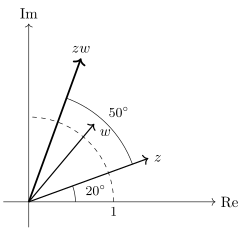
In words: to multiply two complex numbers,
multiply their moduli and add their arguments.
Multiplying by a fixed is therefore a rotation of the
plane about by
the angle ,
combined with a stretch by the factor . The picture shows
, and for ,
and arguments and .
The arrow for
has length and makes the angle with the positive real axis: it is the
arrow for , turned
by ’s angle and
stretched by ’s
length. The small arc marks the argument of , the large arc marks
the extra turn by the argument of , and the dashed arc is
the unit circle, where the numbers live.
Two special cases are worth isolating. Multiplying by
is a
quarter turn counterclockwise, which explains : two quarter
turns send to
. And , so .
Repeating Theorem 0.6.5 gives
powers.
Theorem
0.6.6 (De Moivre’s Formula)
For every and every , Consequently for every
real .
Proof. We use induction on (Theorem 0.2.7). For
, both sides
equal , since
. Suppose for some . Then by the induction hypothesis
and Theorem 0.6.5. The
consequence follows by the same induction, since by Theorem 0.6.5.
Powers that are painful to expand become one line in
polar form.
Example
(A Power via Polar Form)
Compute .
Solution. The modulus is , and . By Theorem 0.6.6, Expanding with the
binomial theorem gives the same answer after seven terms
and some cancellation.
Quick check. Use polar form to
compute .
Solution. We have and . By Theorem 0.6.6, . As a
cross-check, , so .
Roots of
unity
Polar form also turns the equation into a question
about angles. The most important case is .
Example
(Roots of Unity)
Let be
an integer. Find all with , and draw them for .
Solution. Since , every
solution is non-zero, so we may write with
. By Theorem 0.6.6, ,
and . By uniqueness of the polar form up to
multiples of ,
holds
exactly when and for some integer . Since is real, forces . Hence the
solutions are Put . By Theorem 0.6.6,
for . Two
integers give
the same number exactly when is a
multiple of ,
that is, when
divides . So
there are exactly
distinct solutions, the -th roots of
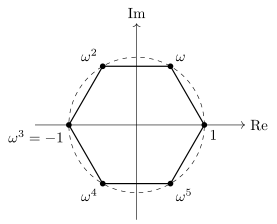
unity. They sit on the unit circle at equally
spaced angles. For they are the corners of a regular polygon
with corners, one
of them at ; for
they are
.
For , the
angles are multiples of , and the roots
are
The six roots sum to : since ,
we have , so the roots cancel in the opposite
pairs , ,
. In the picture, the hexagon is
symmetric about its center . The sum of the -th roots of unity is
for every ; see Exercise (C2: Roots of Unity Sum to Zero).
The
Fundamental Theorem of Algebra
We built so
that one polynomial equation, , has a
solution. It turns out that nothing more ever needs to
be added: every polynomial equation already has a
solution in .
Here a complex polynomial of degree means an
expression with
and ;
polynomials are studied properly in a later section of
this chapter.
Theorem
0.6.7 (Fundamental Theorem of Algebra,
Statement)
Let and
let with . Then there exists with
We do not prove this theorem here. Its proof needs
tools we have not built, and it is proved in Chapter 6.
Nothing in Chapters 0–5 depends on it.
One companion fact needs no heavy machinery. If the
coefficients are real and has , then applying Theorem 0.6.2 (a) and
(b) term by term, and , gives
. So the non-real
roots of a real polynomial come in conjugate pairs. For
example, has the roots and : indeed .
Exercises
A. Check your
understanding
Exercise
(A1)
- (a) Define the
complex conjugate and the modulus
of
, where
.
- (b) State the
triangle inequality for complex numbers.
- (c) True or false:
for all . Justify
your answer.
- (d) True or false:
is a
non-negative real number for every . Justify your
answer.
- (e) True or false:
if and
, then
. Justify your
answer.
- (f) State the
Fundamental Theorem of Algebra.
Solution.
(a) See Definition 0.6.2:
and .
(b) See Theorem 0.6.4: for all .
(c) False. For
and ,
but .
(d) True. By Theorem 0.6.2 (c),
, which is real and
non-negative.
(e) False. For
and , but . (What is true is
that
implies or
.)
(f) See Theorem 0.6.7: every
complex polynomial with and has a root in .
B. Practice
Exercise
(B1: Arithmetic)
Write each of the following in the form with , or as a
real number where indicated.
- (a) .
- (b) .
- (c) , without expanding the product.
- (d) and .
Solution.
(a) Expanding and
using :
.
(b) Multiplying
top and bottom by (Proposition 0.6.3),
(c) By Theorem 0.6.2 (d),
.
(d) By Proposition 0.6.3,
. Hence the real part is
and the
imaginary part is .
Exercise
(B2: A Square Root)
- (a) Find all with .
- (b) Hence solve
.
Hint: for (b), complete the square.
Solution.
(a) Write with . Comparing
real and imaginary parts in gives and . Taking moduli, by Theorem 0.6.2 (d),
. Adding
and subtracting, and . Since ,
and have the same
sign. Therefore or . Check: , and .
(b) Completing
the square, . So the equation holds exactly when . By
(a), this means or . Hence the solutions are and .
Exercise
(B3)
Let
with . Prove
that if and only if .
Solution. By Proposition 0.6.3,
.
Suppose . Then .
Suppose . Then . Since , also , so
multiplying both sides by gives
, that is, . As
, this forces . This
proves the equivalence.
Exercise
(B4: Polar Form)
- (a) Compute .
- (b) Find all with , in the form
.
Solution.
(a) We have and . By
Theorem 0.6.6, .
(b) Since , write with
. Also
. By Theorem 0.6.6, .
By uniqueness of polar form up to multiples of , holds exactly
when and
for some integer . Therefore and . The values give , and every
other differs
from one of these by a multiple of , which changes by a multiple of
. Hence the
solutions are Check: .
C. Going deeper
Exercise
(C1: Reverse Triangle Inequality)
Prove that for all .
Hint: write .
Solution. Let . Since , the
triangle inequality (Theorem 0.6.4) gives
, so . Swapping the roles of
and gives . Moreover by Theorem 0.6.2 (d). The
real number
equals one of and , and both are at most . This
proves the inequality.
Exercise
(C2: Roots of Unity Sum to Zero)
Let and
.
- (a) Prove that .
- (b) Deduce that
and .
Hint: compare with , where is the sum in
(a).
Solution.
(a) Let . By Theorem 0.6.6, . Therefore so . Since , we have , so and . Hence , and
multiplying by (Proposition 0.6.3)
gives .
(b) By Theorem 0.6.6, for each . Since addition in
is coordinate
by coordinate, the real part of is and the imaginary part is . By (a), , so both sums are .
Exercise
(C3: Symmetries of Fixing )
Let be a function with and for all , and for every
.
- (a) Prove that .
- (b) Prove that the
only complex numbers with are and .
- (c) Deduce that
either for every , or for every .
- (d) Show that does
satisfy all three conditions on .
Hint: for (b), write and compare
real and imaginary parts.
Solution.
(a) Since respects products
and fixes the real number , we get .
(b) Let with and . Comparing real
and imaginary parts in gives and . If , then , which is
impossible for real . Hence , so and . Therefore
or , and both satisfy
.
(c) By (a) and
(b),
or .
Let with
. Since
respects
sums and products and fixes and , If , this gives for every
. If , it gives
for every .
(d) By Theorem 0.6.2 (a) and
(b), conjugation respects sums and products. For , . So conjugation satisfies all three
conditions.