Sections 01 and 02 looked at a convex set from the
inside: which combinations of its points it contains,
and how few points a combination needs. This section
looks at it from the outside. A point that is not in a
closed convex set can be cut off from it by a
hyperplane, a set can be touched at its edge by a
hyperplane that leaves the whole set on one side, and
two disjoint convex sets can be pulled apart by one. All
three facts come from a single construction, the point
of the set nearest to a given point, and that
construction is Chapter 11’s orthogonal projection with
the subspace replaced by a convex set.
Throughout, is a finite-dimensional
real inner product space, with inner product
(Definition 11.1.1),
induced norm (Definition 11.1.3),
and . A
sequence converges, , when ;
closed means closed in the sense of Definition 18.1.6, so
that a closed set contains the limit of every convergent
sequence of its points. A set is
compact if every sequence in it has a
subsequence converging to a point of the set; this is
the word of Corollary 16.2.5, which says
that every closed bounded subset of is compact. The field
is because the
whole section is about inequalities.
The
nearest point of a closed convex set
Chapter 11 answered a question about subspaces: given
and a
finite-dimensional subspace , which vector of is closest to ? Theorem 11.3.5 said
there is exactly one, the orthogonal projection , and that is
perpendicular to .
Now replace by a
set with less structure, such as a disc, a box or a
half-plane, and ask the same question. Two small
experiments in show which
hypotheses the answer needs.
- The open disc
and the point . The points of the disc come closer and closer to
, but the
distance is never
reached, since the only candidate is missing. There
is no nearest point. The set is convex but not
closed.
- The circle
and the point . Every point of the circle is at distance
, so every point
is a nearest point. The set is closed but not
convex.
So we ask for both properties, and then everything
works.
Theorem
18.3.1 (Nearest Point Theorem)
Let be a
non-empty, closed, convex subset of
, and let .
The nearest point is written , and the map
is the projection onto . The number
is the distance from
to .
Idea. Three jobs, three tools. ①
Existence: a nearest point is a minimum of the
continuous function , and a minimum exists on
a compact set;
itself may be unbounded, so cut it down to the part of
within a fixed
distance of . ②
The inequality Eq. 18.3.1 is the
first-order condition: slide from a little way towards
another point of
, which convexity
allows, and ask that the distance not decrease. ③ Read
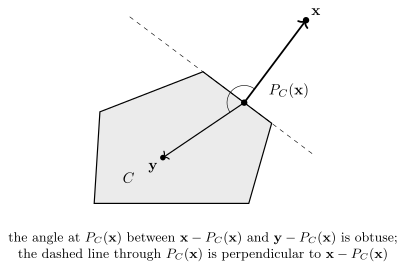
backwards, the inequality says that the angle at between and is at least a
right angle, and expanding then
gives . That
inequality proves both that is nearest and that
nothing else is.
Proof. Existence. Since
,
pick and
put . Let Then , and
is bounded, since for by Corollary 11.1.6.
It is closed: if and , then because is closed, and for every ; the right-hand side
tends to , and a
non-strict inequality survives a limit, so . By
Corollary 16.2.5, the form
in which Chapter 16 carried the compactness of
closed bounded sets, fact (A3) of Chapter 16’s
introduction, over to every finite-dimensional
space, is
compact. The function is continuous, since by Lemma 16.1.1. By the
extreme value theorem, fact (A4) of Chapter 16’s
introduction, attains a minimum on
at some . Every has
. So for every .
(b), . Let
be a nearest
point and let . For , the point lies in by Definition 18.1.1.
Hence, expanding with Theorem 11.1.2 (c)
over , Cancel and divide by : . This holds for
every , and
letting gives Eq. 18.3.1.
(b), , and
uniqueness. Let satisfy Eq. 18.3.1, and let
. The same
expansion with gives So , and is a nearest point.
Finally, the nearest point found in the existence
step satisfies Eq. 18.3.1 by , so applies to it; for
with it gives ,
and is not a
nearest point. This proves the theorem.
The inequality is Pythagoras with
the equality relaxed to an inequality. That is exactly
the relation with Chapter 11, and it deserves to be said
precisely.
This theorem generalizes Theorem 11.3.5.
Let be a
subspace of . It
is convex, and closed by Proposition 18.1.6 (c).
For , the
vector runs
over all of as does, and with each
it also
takes the value . So Eq. 18.3.1 says
and , that is, For a subspace the variational
inequality becomes an equality, the statement
. Then is the splitting of Theorem 11.3.2 (a),
so
by Definition 11.3.2,
and becomes
the equation of Theorem 11.1.3 used
in the proof of Theorem 11.3.5. The
projection onto a closed convex set is the orthogonal
projection with “perpendicular” weakened to “at an
obtuse angle”.
Example
(Three projections)
Find in
each case, and check Eq. 18.3.1.
- (a) is the closed unit ball
of ,
and .
- (b) is the box with the dot
product, and .
- (c) is the half-space , where , and .
Solution.
(a) .
With we have and , so for because and by Theorem 11.1.5. By
Theorem 18.3.1 (b),
is the nearest
point, and .
(b) Clamp each
coordinate into : . Then and, for , since , and . So and . The vector
also cuts off:
and , so , and
the plane strictly separates from , since its left side
is at most on and
equals at . Theorem 18.3.2 below
turns this recipe into a theorem.
(c) Put , which is positive, and . Then
, so
, and for
So : drop the perpendicular to the
boundary hyperplane, as Chapter 11 would have done. The
distance is .
Two degenerate cases fix the scale. If is a single
point, then for every , and Eq. 18.3.1 holds because
. If
, then is the identity. In
every case exactly when .
Quick check. Where did the proof of
Theorem 18.3.1 use that
is closed, and
where that it is convex? Match each use with one of the
two failing experiments before the theorem.
Solution. Closedness was used in
the existence step, to make closed and hence
compact; the open disc fails there, since the minimizing
candidates converge to a point outside it. Convexity was
used in , to know
that , and uniqueness rests on that step. The
circle fails there: with , and , .
Warning. The proof needs an
inner product, and uniqueness can fail without
one. In with , let
be the -axis, which is closed
and convex, and . Then
for every , so there is a whole segment of nearest
points. Existence survives, since its proof used only
(N3) and compactness. Uniqueness does not, because it
came from the expansion of , which
is available only for induced norms.
Hyperplanes and half-spaces
A hyperplane in the sense of Chapter 5 passes through
: it is a
subspace of codimension (Definition 5.5.2). To
separate sets we need translates of hyperplanes, and
Chapter 5 §06 called a coset of a hyperplane
(Definition 4.4.2)
an affine hyperplane. In an inner
product space these have a concrete form. By Theorem 5.5.3, for a
non-zero ; by Theorem 11.5.1,
for a non-zero . Hence and conversely every such set with is an affine
hyperplane, with
as a normal vector. It cuts into the two
closed half-spaces and . Both are convex, because is
linear, and closed by Proposition 18.1.6
(c).
Definition
18.3.1 (Separation by a Hyperplane)
Let be non-empty. A non-zero
vector and
a number
separate and if They strictly separate and if in addition there is
a real with and for all , .
In words: lies
in one closed half-space of
and in the other,
and strict separation puts a slab of width
between them. Replacing by swaps the roles of and . With and any two sets would
be “separated”.
Cutting
off a point
The first consequence of Theorem 18.3.1 is the
one the chapter uses most. If is not in , the vector from to is a normal vector for
a hyperplane that cuts off.
Theorem
18.3.2 (Separating a Point from a Closed Convex
Set)
Let be non-empty, closed and convex, and let
. Put
.
Then and
In particular and strictly separate and .
Proof. Write . Since and , . For
, Eq. 18.3.1 gives , hence With this reads , while . This proves the theorem.
In the picture after Theorem 18.3.1, the
hyperplane of the theorem is the line parallel to the
dashed one, halfway between and .
The theorem turns into a description of a closed
convex set from the outside. Sections 01 and 02 built
convex sets up from points; this builds them down from
half-spaces.
Corollary
18.3.3 (A Closed Convex Set Is an Intersection
of Half-Spaces)
Every non-empty closed convex subset of is the intersection of
all the closed half-spaces , with , that contain .
Proof. Each of these half-spaces
contains , so
lies in their
intersection. Conversely, let . By Theorem 18.3.2, with
, the half-space contains but not . So is not in the
intersection. (If , the family of half-spaces is empty and its
intersection is
by convention.)
The corollary has a converse that is immediate: an
intersection of closed half-spaces is closed and convex,
because each half-space is and both properties pass to
intersections. So the closed convex sets are
exactly the intersections of closed
half-spaces. §04 turns this into a formula, the support
function, and §09 studies the case of finitely many
half-spaces.
Supporting
hyperplanes
A point on the edge of cannot be cut off,
because it belongs to . The best one can hope
for is a hyperplane through the point with all of on one side, touching
without cutting
it. To say “on the edge” we need two more words.
Definition
18.3.2 (Interior Point, Closure, Boundary
Point)
Let . A point is an interior point of
if there is a
real such
that every with
lies in ; the set
of interior points is written . The
closure of is the set of limits of
all convergent sequences of points of . A boundary
point of
is a point of that is not
an interior point of .
Constant sequences show , and by Definition 18.1.6, is closed exactly when
. By
Theorem 16.2.2 neither
notion depends on the norm used: a ball of radius for one norm contains a
ball of positive radius for any other. For the closed
unit disc of ,
the interior points are those with , and the
boundary points form the unit circle. A segment in has no interior
points at all, so every one of its points is a boundary
point; that is the case the next lemma isolates.
Lemma
18.3.4 (A Convex Set Is Solid or Flat)
Let
and let be non-empty and convex. Then
either has an interior point,
or lies in an affine
hyperplane: there are and with for
every .
Idea. Fix and look at
the directions available inside . If they span a proper
subspace, a normal vector to that subspace is the we want. If they span
, then contains points in general
position, hence the solid simplex they span, and the
center of a solid simplex is an interior point because
its barycentric coordinates change only a little when
the point moves a little.
Proof. Fix and let .
Case 1: . Then , so by Theorem 11.3.2 (c),
and there is in . For , , that is, . Take .
Case 2: . Choose a linearly independent list
with every and as large as possible;
by Theorem 1.6.3. Every
vector
with lies
in the span of this list, since otherwise Lemma 1.5.3 would
lengthen it. So the span contains every generator of
, hence equals
, and the list is
a basis; thus . Let be the
-th coordinate of
in this basis, a
linear functional by Theorem 1.5.2, and
write by Theorem 11.5.1. Put
. Then for every , and when for every and ,
this is a convex combination of points of , hence a point of : by Theorem 18.1.3 it lies
in , and
by Definition 18.1.4, since
is itself a
convex set containing .
Let , so that
for every . Each , because
; put and . If ,
then by Theorem 11.1.5
so and
. Hence
, and is an interior point
of .
The second ingredient says that from an interior
point one can see the whole closure.
Lemma
18.3.5 (Closure and Interior of a Convex
Set)
Let be convex.
- (a) is closed and
convex.
- (b) If ,
and ,
then .
Idea. Part (a) pushes limits
through: a limit of limits is a limit, and a convex
combination of limits is the limit of convex
combinations. For (b), picture a small ball around inside , and the cone from
over it. The
cone contains a smaller ball around ; since
is only a limit,
replace it by a nearby point of , which shrinks the ball
by half.
Proof.
(a) Let with
. Each
is a limit of
points of , so
there is
with . Then , so . For
convexity, let and with , and . The points lie
in and converge
to ,
by Corollary 11.1.6,
so that point lies in .
(b) Take with every
point within distance of in , and put . If
then and there is
nothing to prove, so let . Choose with , possible because is a limit of points
of . Let , and put , so that . Since , Hence , and by Definition 18.1.1. So
every point within of lies in , and .
Now the theorem. It asks only that not be an interior
point, which covers the boundary points of and also the points
outside .
Theorem
18.3.6 (Supporting Hyperplane Theorem)
Let , let be convex, and let be a point
that is not an interior point of . Then there is a
non-zero with If moreover , the affine hyperplane passes through and has in one of its closed
half-spaces; it is called a supporting
hyperplane of at .
Idea. Approach from outside and cut off
each approximating point with Theorem 18.3.2. The
normal vectors, scaled to length , live on the compact
unit sphere, so a subsequence converges, and in the
limit the strict inequalities become the non-strict one
we want. The only thing that could go wrong is that
there are no points outside near . Lemma 18.3.4 and Lemma 18.3.5 rule that
out: if is flat,
its own hyperplane serves; if is solid, pushing directly away from
an interior point leaves at once.
Proof. If , any
non-zero works,
and one exists because . So let .
Case 1:
has no interior point. By Lemma 18.3.4 there are
and with for
all . If
, then
works. Otherwise works, since .
Case 2:
has an interior point . For let . We claim . Indeed, with , so if were in , then would be an interior
point of by Lemma 18.3.5 (b),
contrary to the hypothesis. By Lemma 18.3.5 (a), is non-empty,
closed and convex, so Theorem 18.3.2, applied
to and
, gives with for all , in
particular for all . Put , a unit vector satisfying the
same inequality.
The unit sphere of is compact by Corollary 16.2.5, which
rests on fact (A3) of Chapter 16’s
introduction. So a subsequence converges to
some with ; in
particular . Fix . Then for every , and because
. By Theorem 11.1.5,
which tends to . A non-strict
inequality survives the limit, so . This proves the theorem.
A supporting hyperplane need not be unique. At the
corner of
the square , every with , not both
zero, works, since on the square. At a point
of the unit circle, the boundary of the disc, only the
positive multiples of the point itself work. Corners
admit many supporting hyperplanes and smooth points one;
§08 builds its induction on dimension on these
hyperplanes, and §04 uses them to prove that a norm is
recovered from its dual.
Separating
two convex sets
To separate two sets, separate one point from one
set: the point
from the set of differences.
Theorem
18.3.7 (Separating Hyperplane Theorem)
Let be non-empty, disjoint and
convex.
- (a) If is
compact and is
closed, then and are strictly
separated: there are and
with for all , , and indeed
with a margin as in Definition 18.3.1.
- (b) In general,
and are separated: there
are and
with for all , .
Idea. The difference set is convex and misses , and a normal with on its positive side
separates from
. For (a),
compactness of
makes closed, and
Theorem 18.3.2 cuts
off; for (b),
is not an
interior point of , and Theorem 18.3.6
applies.
Proof. Let . It is convex: for , a difference of a point of and a point of . And , since .
(a) We show is closed. Let with
, . Since is compact, a
subsequence converges to
some .
Then , since a
subsequence of a convergent sequence has the same limit,
part of the elementary algebra of limits that Chapter
16’s introduction imports; so because
is closed, and
. Now Theorem 18.3.2, applied
to and the point
, gives
with
for all . With this says Fix . The numbers , , are bounded
above by , so by the completeness of
, fact (A1) of
Chapter 16’s introduction, they have a least
upper bound , and
for every . Take and . Then
and .
(b) If , two non-empty
subsets both contain and cannot be
disjoint, so . The point is not in , so it is not an
interior point of . By Theorem 18.3.6 there is
with
for all . With , this says for all , . As in (a),
the least upper bound of the numbers , , exists by
(A1) and satisfies . This proves the
theorem.
Where
strict separation fails
Part (a) asked one of the two sets to be compact.
That hypothesis cannot be weakened to “closed”, and the
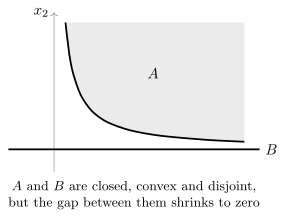
standard witness is a hyperbola and its asymptote.
Example
(A hyperbola and its asymptote)
In with
the dot product, let Show that and are non-empty,
disjoint, closed and convex, that the -axis is the
only hyperplane separating them, and
that they are not strictly
separated.
Solution. Non-empty and
disjoint. and ; every point of has , and every
point of has
.
is closed
and convex. It is a subspace, so it is convex, and
closed by Proposition 18.1.6
(c).
is
convex. Let and , and let . Its coordinates are positive.
Expanding, By , we get , using and . Hence , and .
is
closed. If with , then the coordinates converge, so , and
by the algebra of limits, so . A product
that is at least
has no zero factor, so , and .
The only separating hyperplane. Let and separate and , in either order. On
,
for all real , and
these values lie on one side of ; that forces . So , and after
replacing
by we may
take . On
the value is
. On the values are , and since for every
, they fill
the interval . These are unbounded above, so is on the side and on the side : for
every ,
which forces .
The hyperplane is the -axis, and it
separates, since on and
on .
No strict separation. Strict separation
would need the only separating hyperplane to miss both
sets, and
is that hyperplane.
The points and are
apart, and Exercise (C2: Strict separation and distance)
shows that this vanishing distance is exactly what rules
out strict separation.
Warning. Disjoint closed
convex sets need not be strictly separated. The
hyperbola region and its asymptote above are the example
to remember: both closed, both convex, disjoint, and
every hyperplane that separates them contains one of
them. “Disjoint” gives only the weak separation of Theorem 18.3.7 (b).
Strict separation needs more, such as compactness of one
set in (a).
Extending
linear functionals
Separation has an analytic twin. Instead of a set and
a point, take a linear functional defined on a subspace
and bounded there by a convex function; can it be
extended to the whole space without breaking the bound?
The bounds allowed are the following.
Definition
18.3.3 (Sublinear Functional)
Let be a real
vector space. A function is sublinear
if, for all and
all real ,
Every norm is sublinear: (N3) is the first condition,
and (N2) with the second. Every linear functional is
sublinear, with equality in the first condition. So is
on , which is neither a
norm nor linear: . Taking gives . A non-example by minimal change is : the
first condition fails at (it would give ), and so does the second, since
.
It turns out that sublinearity is exactly what makes
one-step extensions possible.
Theorem
18.3.8 (Hahn–Banach Theorem,
Finite-Dimensional)
Let be a
finite-dimensional real vector space,
let be a
sublinear functional on , let be a subspace of , and let satisfy for every
. Then
there is with
Idea. Add one dimension at a time.
On , a
linear extension is fixed by one number . The
requirement
at the vectors with gives upper bounds on , and at those with
it gives
lower bounds. Sublinearity of , together with
linearity of , is
exactly what makes every lower bound at most every upper
bound, so some
fits. Then induct on . No inner product is needed.
Proof. We induct on . If
, then and works.
Let and
assume the theorem whenever the difference of dimensions
is . Pick
and let . Each can be written as with and , and only in
one way: if with , then , which is false; so and . Appending
to a basis of
gives a basis of
by Lemma 1.5.3, so
. For , the formula
therefore defines a linear functional on that extends .
For , linearity of , the hypothesis, and
sublinearity of
give that is, . So
every number in is at most every
number in . By
fact (A1) of Chapter 16’s introduction,
the non-empty set , bounded above by any
element of , has a
least upper bound , and for every . With this , we check in three cases.
- : this is
the hypothesis .
- : , the element of at . Multiply
by and use : .
- :
, since this is an element of . Multiply by : , that is, .
So on
. By the induction
hypothesis applied to and , there is extending
, hence , with on . This proves the
theorem.
Beyond finite dimension. The
induction above stops after steps. In
an infinite-dimensional space there is no last step, and
the one-step extension has to be combined with Zorn’s
lemma (Theorem 1.8.1),
exactly as Chapter 1 §08 combined “append one vector”
with Zorn’s lemma to prove Theorem 1.8.3. The
resulting theorem, the Hahn–Banach theorem of functional
analysis, is outside the scope of this book, and nothing
here depends on it.
The special case that matters most is a norm.
Corollary
18.3.9 (Norm-Preserving Extension)
Let be a
finite-dimensional real vector space with a norm , let be a subspace, and let
satisfy
for every . Then there is
extending with
for every .
Proof. A norm is sublinear, so Theorem 18.3.8 with
gives extending
with for
all . Applying
this to gives
by (N2). Hence .
In particular, for any , taking and
produces a functional with and
everywhere: a linear functional
that “sees” the full length of without ever exceeding
the norm. §04 meets this functional again, as the vector
at which a dual norm is attained.
Example
(Many extensions)
On with
, let
and .
Find every as in
Corollary 18.3.9, and
compare with the interval produced by the proof of Theorem 18.3.8 for .
Solution. First, , so the
hypothesis holds. An extension has for some
, and then , so .
If , then . If , then gives . If , then gives . So
the extensions are exactly
with :
infinitely many.
In the proof, with , and , the elements
of are , which is for and for ; so . The elements
of are , which is for and for ; so
. Every
between and works, and that is
the interval
found directly. The proof picked its left end.
The corners of the square are why the
extension is not unique: meets the unit sphere
at the corner , and every supporting line of the square at
that corner gives an extension.
Exercises
A. Check your
understanding
Exercise
(A1)
- (a) State the
characterization Eq. 18.3.1 of the
nearest point, and say what it becomes when is a subspace.
- (b) Which two facts
of Chapter 16’s introduction does the existence of use, and to which
set are they applied?
- (c) Determine
whether the following statement is correct, and justify
your answer: every non-empty closed subset of has a unique point
nearest to .
- (d) Determine
whether the following statement is correct, and justify
your answer: two disjoint non-empty closed convex
subsets of
can always be strictly separated.
Solution.
(a) A point is exactly when
for every (Theorem 18.3.1 (b)). For
a subspace it
becomes the equality
for every ,
so
and Theorem 11.3.5 is
recovered.
(b) The
compactness of closed bounded sets (A3), through Corollary 16.2.5, and the
extreme value theorem (A4). They are applied to , the part of within the distance
of attained at one chosen
point of , and to
the function .
(c) Incorrect.
The unit circle is closed and non-empty, and every one
of its points is at distance from . Uniqueness needs
convexity.
(d) Incorrect.
The region above
the hyperbola in the positive quadrant and its asymptote
, the -axis, are disjoint,
closed and convex, but the only hyperplane separating
them is itself
(Example (A hyperbola and its asymptote)).
B. Practice
Exercise
(B1: Projection onto a half-plane)
In with
the dot product, let and . Find and , and verify Eq. 18.3.1.
Solution. Here , , and . By Example (Three projections)
(c), and . Check: , so , and
,
so
for . By Theorem 18.3.1 (b) this
is the nearest point, and .
Exercise
(B2: Cutting off a point from a diamond)
Let , with the dot product, and .
- (a) Show that .
- (b) Hence find the
strictly separating hyperplane of Theorem 18.3.2, and
check it directly.
- (c) Find every
supporting hyperplane of at .
Solution.
(a) Let , which lies in . Then and, for , because .
By Theorem 18.3.1 (b),
.
(b) With , we have
and , so . The hyperplane is the line .
Directly: on ,
, while .
(c) Let satisfy for all . Taking and gives and , that is, and ; so . Taking gives , so , and since . Conversely
with
works, by
the inequality in (a). So the only supporting hyperplane
at is the line
through the edge containing .
Exercise
(B3: A unique extension)
On with
, let
and . Show that satisfies the
hypothesis of Corollary 18.3.9, and
find every extension that the corollary
allows.
Solution. , so the hypothesis holds. Every
is (Theorem 5.1.1), and it
extends exactly
when , that is, .
Next, for all holds exactly when
and . Indeed, if both hold then
; and
if, say, , then gives .
So we need with and .
The first gives , the second ; hence and . The only
extension is .
C. Going deeper
Exercise
(C1: The projection does not stretch)
Let be non-empty, closed and convex. Prove that
for all .
Hint: write Eq. 18.3.1 once at , tested with the point
, and once
at , tested with
, and
add.
Solution. Put and . By Theorem 18.3.1 (b),
applied at with
the point
and at with the
point ,
The second is . Adding, , that is, by Theorem 11.1.5. If
there is
nothing to prove; otherwise divide by .
This proves .
Exercise
(C2: Strict separation and distance)
Let be non-empty, closed and convex, and put
.
- (a) Prove that if
and are strictly
separated, then .
- (b) Prove that if
, then
and are strictly
separated.
- (c) Hence deduce,
without the computation of Example (A hyperbola and its asymptote),
that the sets and
there are not
strictly separated.
Hint for (b): replace the difference set of Theorem 18.3.7 by its
closure.
Solution.
(a) Let , and
strictly separate the sets, with on the side . For
and
, Theorem 11.1.5
gives so . Hence .
(b) Let , which is convex by the computation in
the proof of Theorem 18.3.7. Every
has , and
so does every point of : if with , then
for every , and
the right side tends to . So ,
and is
non-empty, closed and convex by Lemma 18.3.5 (a). By Theorem 18.3.2 there is
with
on .
With , this
is for all , , and the last
paragraph of the proof of Theorem 18.3.7 (a) turns
it into strict separation with .
(c) The points
and
are at
distance , so
for
every , and
. By (a),
and are not strictly
separated.