By Theorem 18.1.3, the
convex hull of a set consists of the convex
combinations of points of , with any number of
points allowed. For a hundred points in the plane, that
description permits a single point of the hull to be an
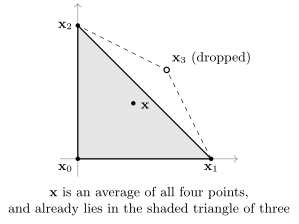
average of all hundred at once. A picture says that this
is wasteful: the hundred points spread out into a
polygon, the polygon can be cut into triangles with
corners among the points, and every point of the polygon
lies in one of those triangles, so three points always
suffice. This section proves the general statement. In a
space of dimension , every point of a
convex hull is a convex combination of at most points of the set,
and the bound cannot be lowered. Two consequences
follow. The hull of a compact set is compact, which §08
uses. And from the same counting argument come Radon’s
theorem and Helly’s theorem, which describe how convex
sets in can
intersect.
As in §01, all spaces are real. Carathéodory’s
theorem needs a finite dimension and
nothing else; the compactness corollary needs, in
addition, a norm, and any norm will do.
When there
are too many points
The proof we want has a simple plan. If a point is
written as a convex combination of too
many points, find a way to shift the weights so
that the point stays where it is while one weight falls
to zero. That point can then be dropped. Two things are
needed: a precise meaning of “too many”, and a way to
shift the weights without moving the point.
Both come from one observation. If
and , then for every real , So the weights describe the same point, and they
still add up to .
A relation of this shape is what we need a word for.
A list of points is affinely dependent when some
combination with coefficients adding to zero, not all of
them zero, cancels out.
Definition
18.2.1 (Affine Independence)
Let be a real
vector space and let be a list in , . The list is
affinely independent if, for
all real , It is affinely dependent
otherwise. A relation with and
the
not all zero is an affine
dependence.
In words: this is linear independence (Definition 1.4.1)
with one extra hypothesis, that the coefficients add up
to zero. The extra hypothesis makes the condition easier
to satisfy, and it makes the notion blind to the choice
of origin. Translating every point by changes by
, so a translated list is affinely dependent
exactly when the original is.
Some small cases:
- A single point is always affinely
independent: is forced by the sum condition alone.
- Two points are affinely dependent exactly when they
are equal: the condition forces ,
and then has a solution if and
only if .
- Three collinear points are affinely dependent:
satisfy , with .
A non-example by minimal change. The
list in is affinely
independent: the - and -coordinates of give , and then the sum condition gives . Move the
third point to . The list still
spans the same line as , but now with : the three points have fallen onto one
line, and the implication in the definition fails.
Warning. Affine
independence is not linear independence. The
list in is linearly
dependent, since it contains , yet it was just shown
to be affinely independent. A triangle is an affinely
independent list of three points in a two-dimensional
space, which linear independence would never allow. That
is why the bound in this section is , and not . The implication does
run one way: a linearly independent list is affinely
independent, since an affine dependence is in particular
a linear relation with coefficients not all zero.
The next lemma converts affine dependence into linear
dependence of differences, which is what allows a
dimension count.
Lemma
18.2.1 (Affine Dependence by
Differences)
Let be a real
vector space and .
- (a) The list is
affinely independent if and only if the
list is linearly independent.
- (b) If , every
affinely independent list in has at most entries.
Equivalently, every list of or more points of
is affinely
dependent.
Idea. The sum condition determines
from the
other coefficients, and eliminating it turns an affine
relation among the points into a linear relation among
the differences, and back.
Proof.
(a) Suppose and . Then , and substituting,
Conversely, if , then setting gives an affine relation with . These two passages are inverse to each
other, and is not all zero exactly when
is not all zero, because is determined
by the others. So affine dependences of the points
correspond to linear relations, not all zero, among the
differences, and one exists exactly when the other
does.
(b) If is
affinely independent, then by (a) the differences are linearly
independent, so by Theorem 1.6.3 (a).
The list has entries.
The
theorem
Now the plan can be carried out. The statement is
sharper than the count: the points can be taken affinely
independent, and the count is a consequence.
Theorem
18.2.2 (Carathéodory’s Theorem)
Let be a real
vector space with , and let . Every point of is a convex
combination of an affinely independent
list of points of . In particular, every
point of is
a convex combination of at most points of
.
Idea. Count, then drop a
point. Write with as few points as
possible, so that every weight is positive. If the
points were affinely dependent, the weights would
describe the same for every . Start at and increase . The weights with
decrease, and there is at least one of these, because
the add
up to zero without all being zero. Stop at the first
moment a weight reaches : all the weights are
still , and
one point has become unnecessary. That contradicts
minimality.
Proof. Let . By Theorem 18.1.3, is a convex
combination of finitely many points of . Among all ways of
writing it so, choose one, with the number of points as small as possible. Then every
: a zero
weight could be deleted, and the remaining weights would
still be non-negative and add up to , giving a shorter
expression.
Suppose, for a contradiction, that is
affinely dependent, and let ,
be an affine dependence. The are not all
zero and add up to , so at least one of
them is positive. Put a minimum over a non-empty finite set, and let
be an index where
it is attained; since each . Define . Then:
-
for every . If
,
then , since . If , then by the choice of , so .
- .
- and .
So is a
convex combination of the points , , contradicting
the minimality of . Hence is affinely independent. By Lemma 18.2.1 (b) it has
at most
entries. This proves the theorem.
In the plane, then, every point of the hull of any
set lies in a
triangle whose corners are points of , possibly a degenerate
one (a segment or a single point). In it lies in a
tetrahedron with corners in . The proof is
constructive: given any convex combination, it says how
to shorten it, one point at a time.
Example
(Dropping a point in the plane)
In let
,
,
,
, and
let .
Write as a
convex combination of three of these points by the
method of the proof.
Solution. Four points in are affinely
dependent by Lemma 18.2.1 (b). To
find a dependence, solve
and : the two coordinate equations read and . Taking gives , and then . Check: , and .
The positive coefficients are and , with
ratios and . So , attained at , and the new
weights are Check: , and . So lies in the
triangle with corners , and has been
dropped.
The minimum matters. Using the other positive
coefficient, , would make the weight of equal to : the point would still be described
correctly, but not as a convex combination.
The bound
cannot be improved, and the standard simplex shows
it.
Example
(The bound is attained)
In , let
and let . Show that is not a
convex combination of any points of .
Solution. The point is a convex
combination of the points of , each with weight . A convex
combination of of
the points leaves one out. If it leaves out , the combination is
, whose -th coordinate is , while .
If it leaves out , the combination is
, whose coordinates add up to , while those of add up to .
Either way it is not .
The bound can be far from attained for a particular
set, however, and it is worth seeing one.
Example
(Two points suffice for a circle)
Let be the unit circle. Show that
is the
closed unit disc , and that every point
of is a convex
combination of two points of .
Solution. is convex (Example (The first convex sets)
(d)) and contains , so by
Definition 18.1.4.
Conversely, let , so , and put , which is real since . The
points and
lie on
, and
because . With when , and because . When , we have and , and is itself a point of . So every point of the
disc lies on a vertical chord of the circle, and by
Theorem 18.1.3.
Quick check. A point of is given as a
convex combination of seven points of a set . What is the smallest
number of points of that Theorem 18.2.2
guarantees will suffice? Can one always manage with
three?
Solution. Four, since for . Three do not
always suffice: by Example (The bound is attained)
with , the
point is a convex combination of and
of no three of them.
The hull
of a compact set
The first use of the theorem is a statement about
limits. Recall from Corollary 16.2.5 that a
subset of a
finite-dimensional real space with a norm is
compact if every sequence in has a subsequence
converging to a point of . Compactness
is what lets later sections take a maximum, or a nearest
point, over a hull, and it is not obvious that a hull
keeps it. A convex combination may use arbitrarily many
points, so a sequence of combinations could use more and
more of them, and there would be no single compact set
of parameters from which to extract a convergent
subsequence. Carathéodory’s bound removes that
possibility: every point of the hull is described by
exactly
points of and
weights.
Corollary
18.2.3 (The Hull of a Compact Set Is
Compact)
Let be a
finite-dimensional real vector space with a norm, and
let
be compact.
- (a) is compact.
- (b) If is non-empty, then
every linear functional on attains a maximum on
, and
Idea. For (a), write each term of a
sequence in
as a combination of exactly points of , using Theorem 18.2.2 and
padding with zero weights. That turns one sequence into
sequences:
one of weight vectors in , and of points of . Extract a convergent
subsequence from each in turn, a subsequence of the
previous one each time, and pass to the limit in the
combination. For (b), a linear functional cannot do
better on an average than on the best of the points
averaged.
Proof. Let .
- (a) If , then ,
which is compact vacuously. Otherwise let be a sequence in
. By Theorem 18.2.2, each
is a convex
combination of at most points of ; repeating one of those
points with weight if necessary, we may
write
Step 1: the weights. is closed in
by Proposition 18.1.6 (b),
(c), and bounded, since each coordinate of a point of it
lies in . By
the compactness of closed bounded sets in , fact (A3) of
Chapter 16’s introduction, some subsequence of
converges to
a point . In particular along it
for each , since
.
Step 2: the points. Along that subsequence,
the sequence lies in , so by compactness of
a further
subsequence has . Along it, a further subsequence has
, and so on through . A subsequence of a
convergent sequence converges to the same limit, so
along the final subsequence, which we index by again, and for
every .
Step 3: the limit. Put , which lies in by Theorem 18.1.3. By (N3)
and (N2) of Definition 16.1.1, along the
final subsequence, where the second line writes .
Each is
bounded, since the last term tends to . So every term on the
right tends to ,
and along the subsequence. Hence is
compact.
- (b) By Lemma 18.1.5, is continuous. By
the extreme value theorem, fact (A4) of Chapter
16’s introduction, applied to on the non-empty
compact set ,
there is with for every . Now let be
any point of , with and (Theorem 18.1.3). By
linearity, and since every , So
bounds on
, and it is
attained there, at . This proves the
corollary.
For instance, takes the values at the corners
of the triangle in Example (Dropping a point in the plane);
as in the proof of (b), at a point of the
triangle it takes the average of
these values, so its maximum over the triangle is , attained at . At the interior
point it takes , an
average of the corner values and so no larger than the
largest.
To maximize a linear functional over the hull of
finitely many points it is enough to evaluate it at
those points (Exercise (B3: Linear functionals on a polygon)).
§08 extends this to every compact convex set, and §09
shows that a bounded feasible region of §06 is such a
hull.
Warning. The hull of a
closed set need not be closed. In , let , a point together with a line. is closed, by Proposition 18.1.6 (b),
(c). Its hull is Indeed a convex combination of points of with total weight on has second
coordinate , and
when any
first coordinate
is reached, as ; when
all the
weight is on . The points lie in and converge to
, which does
not. So compactness in Corollary 18.2.3 cannot
be weakened to closedness: here is closed but
unbounded, and the hull loses the line , except for the one
point that belongs to .
Radon’s
theorem and Helly’s theorem
The dimension count behind Carathéodory’s theorem
says something about intersections of convex sets as
well. Its first form is a statement about points.
Theorem
18.2.4 (Radon’s Theorem)
Let be a real
vector space with , and let with . Then the
index set can be split into two
disjoint non-empty sets and with
Idea. Take an affine dependence and
separate its positive coefficients from the rest. Moving
the negative terms across the equation gives an equation
between a positive combination of some points and a
positive combination of the others, with the
same total weight on each side, because
the coefficients add up to zero. Divide by that total,
and each side becomes a convex combination.
Proof. By Lemma 18.2.1 (b), the
list is affinely dependent: there are , not all zero, with
and . Let and , which are disjoint with union . Since
the add
up to and are not
all zero, some is positive and
some is negative, so neither nor is empty. Put ; then as well, since the total is . Moving the terms
indexed by across
and dividing by , On the left the coefficients are positive and
add up to ; on the
right they are and add up to . So lies in both hulls, by
Theorem 18.1.3. This
proves the theorem.
A partition as in the theorem is a Radon
partition. In the plane, four points in general
position (no three on a line) either have one inside the
triangle of the other three, or they form a
quadrilateral whose two diagonals cross; Exercise (B2: Radon partitions in the plane)
finds the partition in each case. The count cannot be lowered:
the points
have no Radon partition (Exercise (C3: The counts are sharp)).
Helly’s theorem turns the counting around. Instead of
asking how many points a hull needs, it asks how many
sets of a family must be checked to know that all of
them have a common point. Checking pairs is not enough,
since three lines in the plane can meet pairwise in
three different points; checking triples in the plane
is.
Theorem
18.2.5 (Helly’s Theorem)
Let be a real
vector space with , and let be convex subsets of , with . If
every of the sets have a point in common, then all
of them have a
point in common.
Idea. Induction on the number of
sets. Given sets, the inductive hypothesis provides, for
each , a point
lying in every
set except possibly . That is points, so
Radon’s theorem splits them into two groups whose hulls
meet at some .
Any one set
misses at most one point, , and that point lies
in only one of the two groups; the other group lies
entirely in ,
and so does its hull, which contains .
Proof. We use induction on . For , the hypothesis
applied to all
sets is the conclusion. Let , and suppose
the theorem holds for families of convex sets. For
each , the family has members, and every of them have a
common point by hypothesis. By the inductive hypothesis,
there is a point with Since , Theorem 18.2.4 splits
into disjoint non-empty sets , and gives a point .
Fix . If , then , so every with lies in . Since is convex, Lemma 18.1.2 puts every
convex combination of these points in , so by Theorem 18.1.3, and in
particular . If , the same argument with in place of gives . Hence lies in every . This completes the
induction.
Example
(Helly’s proof run on four half-planes)
In , let
Find points in all the sets
except , and
follow the proof of Theorem 18.2.5 to a
common point of all four.
Solution. Here and , so the
proof applies Radon’s theorem (Theorem 18.2.4) to four
points. The following points lie in every set except
their own, as substitution into the four inequalities
shows: For instance, has , , , and
violates . And
has , , , and violates
.
An affine dependence: the equations ,
are satisfied by 𝛌. Check: the first coordinates
give , the second , and . The positive coefficients are at
, with
, so
and from the other side , as it must be. Finally
satisfies , , and : it lies in all four
half-planes. The proof explains why, without any
checking: and
contain and , hence the segment
between them, which contains ; and and contain and , hence the other
segment through .
With these results the chapter has its combinatorial
foundation. §03 turns to geometry: a point outside a
closed convex set can be separated from it by a
hyperplane.
Exercises
A. Check your
understanding
Exercise
(A1)
- (a) State Theorem 18.2.2.
- (b) True or false:
every point in the convex hull of ten points of is a convex
combination of three of them. Justify your answer.
- (c) True or false:
the convex hull of a closed subset of is closed. Justify
your answer.
- (d) True or false:
any four points of have a Radon
partition. Justify your answer.
- (e) Is the list
in affinely
independent? Is ?
- (f) Which facts from
Chapter 16’s list of imported analysis does Corollary 18.2.3 use,
and where?
Solution.
(a) If and , every
point of is
a convex combination of an affinely independent list of
points of , and so
of at most
points of .
(b) True, by Theorem 18.2.2 with
: at most
three are needed, and if fewer are used, a point can be
added with weight .
(c) False. The
warning in this section gives , closed, with a limit of points
of not in
.
(d) False.
Radon’s theorem (Theorem 18.2.4) needs
points in
, and four can
fail. The points are affinely independent, since
are linearly independent (Lemma 18.2.1 (a)). A
point common to the hulls of two disjoint groups of them
would give two convex combinations with equal value, and
subtracting them gives a relation with coefficients
adding up to and
not all zero, which is an affine dependence. So there is
no Radon partition; Exercise (C3: The counts are sharp)
carries this out for affinely independent points in
general.
(e) Yes: it is
linearly independent, and a linearly independent list is
affinely independent. The second list is affinely
dependent: with
coefficients , which add up to .
(f) (A3), the
compactness of closed bounded sets, for the weights in
part (a); and (A4), the extreme value theorem, for the
maximum over in
part (b). Part (a) also uses the hypothesis that is compact, once for
each of the
points.
B. Practice
Exercise
(B1: Shortening a combination)
In , let
,
,
,
, and
- (a) Compute , and find an affine
dependence among .
- (b) Use the method
of Theorem 18.2.2 to write
as a convex
combination of three of the points.
- (c) Apply the method
with the dependence multiplied by . Which point is
dropped now? Hence lies in two different
triangles with corners among the .
Solution.
(a) . The corners of a square satisfy
, with . So
𝛌.
(b) The positive
coefficients are at and , with ratios and . So , attained at , and the new weights
are 𝛌. Check:
,
and the weights add up to . So .
(c) With 𝛌, the positive coefficients are at and , with ratios and . So , attained
at , and the
weights become 𝛌. Check: . Now is dropped, and
. The two answers are consistent: the
triangle with corners is the part of the square where
, the
triangle with corners is the part where , and
satisfies both. The shorter combination produced by
Carathéodory’s theorem is not unique; it depends on the
dependence used and on its sign.
Exercise
(B2: Radon partitions in the plane)
Find a Radon partition, and a point common to the two
hulls, for each list of four points in . Justify your
answer.
- (a) .
- (b) .
Solution. Label the points in the
order given, and follow the proof of Theorem 18.2.4.
(a) The equations
, read , , . Taking
gives
and . So , , , and The fourth point lies inside the triangle of
the other three.
(b) The equations
read , , and .
Subtracting the first two gives ,
and then , so
and . Taking
gives 𝛌. So , , , and The two diagonals of the quadrilateral cross
at .
Exercise
(B3: Linear functionals on a polygon)
Let be a
finite-dimensional real vector space with a norm, and
.
- (a) Prove that is
compact, and deduce that is compact.
- (b) Prove that every
linear functional on attains its maximum
over at one of
the points .
- (c) Find the maximum
and the minimum of
over the triangle of Example (Deciding membership in a triangle).
Solution.
(a) Let be a sequence in
the finite set. Some occurs as for infinitely many
, since there are
only candidates,
and those terms form a constant subsequence, which
converges to ,
a point of the set. So the set is compact, and is compact by Corollary 18.2.3
(a).
(b) By Corollary 18.2.3 (b),
the maximum of over equals its maximum over
, which is ,
attained at an
with the largest value.
(c) The values at
the corners are , , . By (b), the maximum over the triangle
is , at . Applying (b) to
, the
minimum is , at
.
C. Going deeper
Exercise
(C1: Carathéodory in the affine hull)
Let be a real
vector space, non-empty, and suppose has
dimension (Definition 18.1.5).
- (a) Prove that every
affinely independent list of points of has at most entries.
- (b) Hence prove that
every point of is a convex combination of at most points of .
- (c) Let . What bound
does Theorem 18.2.2 give, and
what bound does (b) give?
Solution.
(a) By Proposition 18.1.4,
with . If is an affinely independent list in , then each lies in , so each
difference lies in . By Lemma 18.2.1 (a) the
differences are
linearly independent, and they lie in the -dimensional space , so by Theorem 1.6.3
(a).
(b) By Theorem 18.2.2, each
point of is
a convex combination of an affinely independent list of
points of , which
has at most
entries by (a).
(c) Here , so Theorem 18.2.2 gives
. All of lies on the line , and contains two distinct
points, so is
that line and ; (b) gives . Indeed is the segment
from to , and each of
its points is a convex combination of the two
endpoints.
Exercise
(C2: Helly’s theorem for a sequence of compact
sets)
Let be a real
vector space of dimension with a norm, and let
be a sequence of compact
convex subsets of
such that every of them have a common point.
- (a) Prove that a
compact set is
closed.
- (b) Prove that for
each there
is a point .
- (c) Prove that .
- (d) Explain where
the argument fails for the closed half-lines of the remark
after Theorem 18.2.5.
Hint for (c): all the lie in .
Solution.
(a) Let with . By
compactness, a subsequence converges to some . It also
converges to , as
a subsequence of a convergent sequence, and a limit is
unique: , so by (N1). Hence .
(b) For , the sets , together
with , are of the sets, and a common point of all of
them lies in . For , Theorem 18.2.5 applies
to the convex sets .
(c) Every lies in the compact
set , so a
subsequence converges to
some . Fix . For , , and
is closed by
(a); the terms with form a sequence in converging to , so . As was arbitrary, .
(d) Steps (a) and
(b) survive for with : the sets are closed, and lies in the
first of them.
Step (c) fails, because is not compact: the sequence
has no
convergent subsequence, and the points escape to
infinity instead of accumulating at a common
point.
Exercise
(C3: The counts are sharp)
Let be a real
vector space of dimension , and let be
affinely independent.
- (a) Prove that each
point of has exactly one
expression with .
- (b) Deduce that
is not a convex combination of any of the points. (This
recovers Example (The bound is attained).)
- (c) Prove that have
no Radon partition, so that in Theorem 18.2.4 cannot be
lowered.
Solution.
(a) If with , then and . By affine independence
every .
(b) The point has
the expression with all weights . A convex
combination of of
the points is an expression of the form in (a) with the
omitted point given weight . By the uniqueness in
(a), it would have to coincide with the all- expression,
which has no zero weight.
(c) Suppose are disjoint,
non-empty, and with
non-negative weights, each family adding up to . Then is a relation among the
whose
coefficients add up to ; an index lying in neither set gets
coefficient , and
no index lies in both, since . By
affine independence, all these coefficients are , so every , contradicting
. Hence no Radon partition exists.