In Chapter 0 a single number, , decided whether
a matrix
is invertible (Theorem 0.9.8). For an
matrix,
Chapter 3 answered the same question by row reduction,
which is a procedure, not a number. Is there one number
for every square matrix that does the job of ? This section
does not define it yet. Instead it asks what such a
number should mean, finds the answer in
area and volume, and extracts a short list of rules.
From the rules alone, comes out, with no other choice
possible.
Area as a
function of two vectors
Take two vectors and the parallelogram they span,
Its corners are , , and . We want to
understand its area as a function of the two
vectors, without drawing a coordinate grid and
counting squares. Four features are visible without any
formula.
Scaling a side scales the area.
Replacing by
stacks two
copies of
on top of each other, so the area doubles. Replacing
by triples it, and
replacing by
halves
it.
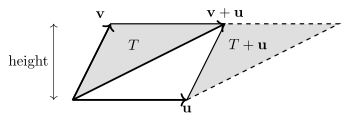
Shearing does not change the area.
Replace by . The top edge
slides along its own line, parallel to the base . The base stays the
same, and so does the height, so the area stays the
same. The picture shows : the triangle cut off on the left of reappears,
moved by , on the
right of .
The solid outline is and the dashed
one completes . Both consist of the unshaded middle
triangle plus a shaded triangle, and the two shaded
triangles and
are
translates of each other.
Equal sides give area zero. is a segment,
which has no area. More generally, if is a multiple of , the parallelogram is
flat.
The unit square has area one. is the unit
square. This fixes the unit of measurement.
Why the
area needs a sign
The first feature is not quite right as stated.
Replacing by
moves the
parallelogram to the other side of the line of (the point reflection
carries
onto )
and does not change its area, so
ordinary area satisfies ,
with an absolute value. That absolute value spoils a
second, very useful property.
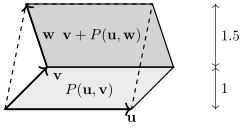
Fix the base
and let the second vector vary. The area is base times
height, and heights along a fixed direction add up: if
reaches height
above the line of
and reaches height , then reaches height
. So we expect
The picture shows it: , moved up by
, sits exactly on
top of ,
and the two together have the same base and total height
as
(dashed).
Now take . Then and the left side is , while the right side is , which is positive. Additivity fails,
because points
below the line of and its height should
count as negative. The repair is to give area a
sign.
Signed area is ordinary area, counted positive
when the second vector lies on the counterclockwise side
of the first, and negative when it lies on the clockwise
side.
So
has signed area ,
because is a
quarter turn counterclockwise from , and has signed
area . With the
sign in place, scaling holds with instead of , and
heights add with their signs, so additivity holds for
all .
Write
for the signed area. The pictures suggest that obeys the following rules, for
all and all :
- (R1)
(Scaling)
and .
- (R2)
(Shear) and .
- (R3) (Equal
sides) .
- (R4)
(Normalization) .
- (R5)
(Additivity) and .
These are rules read off from pictures, not yet a
definition. The question is what they force.
The rules
force
A
matrix has
columns
and ,
and is
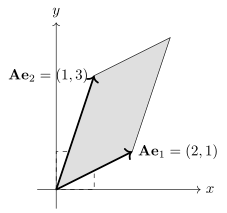
the image of the unit square under . We now
show that the first four rules leave no freedom at all.
The method is the column version of elimination: use
shears to clear entries until the parallelogram becomes
a rectangle.
Example
( from the
Rules)
Let be any function
satisfying (R1)–(R4). Show that for all .
Solution. Write and . Two
consequences of (R1) come first. Taking the scalar in (R1) gives , and likewise . Using (R1)
twice and then (R4),
Case 1: . By the second shear rule with scalar
, If , this is . If , the first
shear rule with scalar clears the
second entry of :
by . In both sub-cases
.
Case 2: and . By the first shear rule with scalar
, , and has first entry . Case 1, applied
to the columns and , gives since .
Case 3: . If , then and . If , the second shear rule with scalar gives . In both
sub-cases .
The three cases cover all , so , as claimed.
So at most one function obeys
(R1)–(R4). Conversely, obeys all five
rules; for instance, for the second shear rule,
replacing by
gives . The other checks are just as short.
Hence exactly one function satisfies
(R1)–(R4), and it satisfies (R5) as well.
Two things in this computation are worth noticing.
First, (R3) was never used. It follows from the others:
, by a shear and then scaling by
. Second, the
argument used only addition, subtraction, multiplication
and division by non-zero numbers. So over
any field , exactly one function
satisfies (R1)–(R4), namely . The picture
needs ; the
algebra does not.
There is also a shorter route, if we allow
additivity. Expanding and with
(R5) and (R1) gives four terms: The first and last vanish by (R3), by
(R4), and (see the Quick check below). This expansion
is the route that generalizes to vectors later in the
chapter, while the elimination route of Example ( from the Rules)
becomes the practical way to compute.
Quick check. Using only (R1) and
(R2), show that for all . Deduce .
Solution. Apply shears and one
scaling: With , and (R4), . This agrees with for the columns .
Now compare with Chapter 0. By Theorem 0.9.8, is invertible
if and only if . In the
language of this section: is invertible exactly
when the parallelogram spanned by its columns is
not flat, that is, when the columns do
not lie on a common line through the origin. The number
that decides invertibility and the signed area of the
image of the unit square are the same number. Drag the
images of and
below and
watch the signed area pass through exactly when the two
columns line up.
Volume in
three dimensions
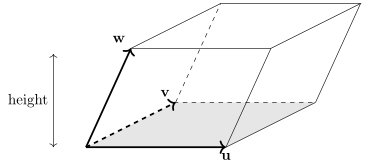
The same story plays out one dimension up. Three
vectors span a parallelepiped
a slanted box whose faces are
parallelograms.
Its volume is the area of the base (shaded) times
the height of
above the plane of the base. Each feature from the plane
has a counterpart:
- scaling one edge scales the volume;
- replacing by
slides the top face within its own plane, so the base
and height, hence the volume, are unchanged, and
similarly for shears of or ;
- if two edges are equal, the box is flat and the
volume is ;
- the unit cube has volume ;
- with a sign attached, heights add, so the signed
volume is additive in each edge.
The sign in three dimensions records whether is arranged
like , the right-hand rule. We make this
precise as orientation later in the chapter. For now the
point is that the rules are the same
rules, now for a function of three
vectors. The Quick check above also carries over word
for word: shearing and scaling two of the arguments
while the third stays fixed shows that swapping two
arguments changes the sign.
What we
will prove
Here is the goal for the next three sections. Let
be a field and
.
There is exactly one function of vectors in that is linear in
each argument separately, is whenever two arguments
are equal, and takes the value at .
Its value on the columns of a matrix will be the
determinant . The plan follows the shorter route for
. Expanding
every argument in the standard basis gives terms. The rule for
equal arguments kills every term with a repeated basis
vector, which leaves one term for each rearrangement
of the standard basis. Each
surviving value is , reached from
by swaps, with one sign change per swap. That creates
two tasks:
- Name and study functions of several vectors with
these rules. This is the next section, on multilinear
alternating forms.
- Make sure the sign of a rearrangement is well
defined, even though it can be reached by different
sequences of swaps. This is the section on permutations
and sign.
The existence and uniqueness theorem itself comes
after both.
Warning. Sarrus’s rule is a
coincidence. For a matrix, the
“diagonals” shortcut (add the three products along the
down-right diagonals of the array with its first two
columns copied to the right, subtract the three along
the up-right diagonals) gives the correct six terms,
because there are exactly rearrangements. The same picture for gives products, while
the expansion above has terms. It fails already for the matrix with
columns : every one of the eight wrapped diagonals
passes through a zero entry, so the shortcut returns
, but the swap
rule gives .
Never use Sarrus’s rule beyond , and never use
it as a proof tool.
Exercises
A. Check your
understanding
Exercise
(A1)
- (a) State the four
rules (R1)–(R4) for signed area.
- (b) True or false:
ordinary (unsigned) area satisfies for all . Justify your answer.
- (c) Find the signed
area of . Is invertible?
- (d) Explain why any
satisfying (R1)
and (R2) has .
- (e) How many terms
does the full expansion for matrices have,
and how many products does the analogue of
Sarrus’s rule use?
Solution.
(a) For all and
: ; ; ; .
(b) False. Take
, , . The left side
is the area of , which is ; the right side is
.
(c) With , , , , the signed area is
. Since , the matrix is invertible by Theorem 0.9.8.
(d) By the second
shear rule with scalar , , and by (R1).
(e) The expansion
has terms,
one for each rearrangement of . The
Sarrus-type diagram has only products, so it must
miss of
them.
B. Practice
Exercise
(B1: Signed Areas from the Rules)
Using only (R1)–(R4), in the manner of Example ( from the Rules),
compute the following. Then check each answer against
.
- (a) .
- (b) .
- (c) .
Solution.
(a) By the second
shear rule with scalar , . By the first
shear rule with scalar , this equals
. By (R1) twice and
(R4), . Check: .
(b) By the second
shear rule with scalar , , and by (R1). So the value
is . Check: . The columns lie on one line, and the
parallelogram is flat.
(c) By (R1)
twice, . By the Quick check (which uses
only (R1) and (R2)), by (R4). So the
value is . Check:
with columns
and , , , , , and . The sign is
negative because lies clockwise from .
Exercise
(B2: Equal Sides Force the Swap Rule)
Let satisfy (R1), (R3) and (R5), but
not necessarily (R2).
- (a) Prove that
for all .
- (b) Suppose moreover
that (R4) holds. Deduce that .
Hint: expand .
Solution.
(a) Let . By
(R3), . Expanding with (R5) in the first argument
and then in the second, where the second equality uses (R3) twice.
Hence .
(b) Write
and . By (R5) and (R1) in each argument, By (R3) the first and last terms are . By (R4), , and by
(a), . Hence .
C. Going deeper
Exercise
(C1: Area of a Triangle)
Let .
- (a) Explain why the
triangle with vertices has area , where is the signed
area.
- (b) Find the area of
the triangle with vertices , , .
- (c) Hence decide
whether the points , , lie on a line. Justify your answer.
Solution.
(a) Translating
by does not
change areas, so the triangle has the same area as the
triangle with vertices , , . That
triangle is half of the parallelogram : the diagonal
from to cuts into the
triangle with vertices and the triangle with vertices , and the
point reflection maps the first onto the second, so
they have equal area. The area of is ,
since the signed area differs from the area only by its
sign. Hence the triangle has area .
(b) Here and
,
so and the area is .
(c) With , and
,
so and the “triangle” has area . Indeed , so
is a
multiple of , and all three points lie on the line
through with
direction .
Yes, they are collinear.
Exercise
(C2: The
Case)
For , the
rules ask for a function of one vector in .
- (a) Explain why the
rule “zero whenever two arguments are equal” imposes no
condition when .
- (b) Prove that the
only function that is linear with is . Hence the
determinant of a matrix must be .
Solution.
(a) The rule
speaks about two different positions
holding
equal vectors. With one argument there is no pair of
positions, so the condition is vacuously true (Example (A vacuously true implication)).
(b) Let be linear with , and let . Since ,
homogeneity gives . Conversely, is linear and
sends to . Hence is the only such
function.