Section 1 reduced our problem to one piece at a time:
on the generalized eigenspace , the
operator is with some power of equal to zero (Theorem 10.1.3
(d)). The scalar part needs no work, so everything now
depends on a single question: what does an operator all
of whose powers eventually vanish look like in the right
basis? This section answers it completely, and the
answer is a list of numbers — the sizes of the
staircases the operator builds.
Operators
killed by a power
The objects have already appeared several times.
Differentiation on satisfies (Example (Differentiation Is Nilpotent)).
The matrix has square
. Over a field of
characteristic , a
commutator
that commutes with has some power equal
to (Exercise (C2: When commutes with )). Chapter 2
gave these operators their name in passing; here is the
definition in full, with the one extra piece of data we
shall need.
A nilpotent operator is one that some power
annihilates: repeated application destroys every
vector.
Definition
10.2.1 (Nilpotent Operator, Index of
Nilpotency)
Let be a
vector space over
and .
We say is
nilpotent if If and is nilpotent, the
index of nilpotency of is the
least such ; equivalently, and . A matrix
is
nilpotent if for some , that is, if
is
nilpotent.
In words: one single exponent must
kill every vector at once, and the
exponent is at least , so the zero operator
is nilpotent (index ) but the identity on
is
not. The index is well defined: the exponents with form a non-empty
set of positive integers, which has a least element (Theorem 0.2.11).
Examples.
- The shift. On , let and for
. Then kills every , while , so
is nilpotent of index . Its matrix in the
standard basis has a in each position and zeros
elsewhere. This matrix is the model for everything in
this section, and we write it with in
every superdiagonal entry and everywhere else.
(Section 3 writes and calls it a Jordan block.) For , .
- Differentiation. on has , and over
the index is
exactly ,
since (Example (Differentiation Is Nilpotent)).
Over , in the
basis , its matrix is exactly , because
.
- All entries non-zero. has ,
so is nilpotent
of index ,
although no entry of is . Nilpotency is not
visible from the shape of the entries.
- The degenerate case. On a space of
dimension the
only nilpotent operator is : if and , then , so . Small as it is,
this is why a block in a nilpotent normal form carries a
and nothing
else.
Non-example by minimal change. Move
the in to the other off-diagonal
position and take , the swap of the two coordinates.
It is just as sparse, but , so and
for every : no
power vanishes, and the defining clause fails outright.
A gentler non-example is , which is
singular and has
as an eigenvalue, yet ; being non-invertible is far from being
nilpotent.
Why this definition. The clause “for
some ” cannot be
replaced by a fixed exponent without losing the class,
since on differentiation needs steps. On the other
hand the exponent may always be taken to be , as the next
proposition shows, so the definition is not as
open-ended as it looks. The name says “zero power”:
nil (nothing) and potens (power).
Warning. Nilpotent is a
statement about one exponent killing everything, not
about each vector separately, and not about the
entries. Differentiation on
(all polynomials) kills every
single polynomial after enough steps,
yet no power of it is , because the number of
steps needed is unbounded; the space is
infinite-dimensional. And the matrix is nilpotent with no
zero entry, while has a zero entry, a zero eigenvalue, and is
not nilpotent.
The first payoff collects the facts we shall use
constantly. Note the interplay with Section 1: a
nilpotent operator is one whose generalized eigenspace
for is
everything.
Proposition
10.2.1 (Basic Properties of Nilpotent
Operators)
Let be a
finite-dimensional vector space over with , and let
.
Then:
- (a) is nilpotent if and
only if ,
if and only if ;
- (b) if is nilpotent with index
, then , and ;
- (c) if is nilpotent, then
,
and there is a basis in which the matrix of is upper triangular
with zero diagonal;
- (d) conversely, if
, then
is
nilpotent.
Idea. For (a) and (b), the kernel
chain of Section 1 does the work: says , and the
chain has stopped growing by step . For the triangular
matrix in (c), build the basis along the chain: take a
basis of ,
extend it to one of , and so on. A vector first appearing at
level is sent by
into , which is
spanned by vectors listed earlier, so
every column has zeros from the diagonal down.
Proof.
(a) If for some , then , so by Theorem 10.1.1 (a)
and (d), that is, . The converse is the definition with . And by Corollary 10.1.2
(a) with , so if and only if .
(b) Let be the index and put
, so
by (a) and Theorem 10.1.1
(a). Choose a basis of ; extend it to a basis
of ; and continuing,
extend to
a basis of
for (Theorem 1.6.5,
legitimate because is an
independent list in ). Then is a basis of , and for each the first of its vectors
form a basis of . Let and let
be the level at
which was
added, so and . Then . So the -th column of has
zeros in rows (Definition 4.1.1,
Theorem 1.5.1): the
matrix is upper triangular with zero diagonal. Its
diagonal entries are, with multiplicity, the eigenvalues
of (Theorem 9.7.4 (b)),
and they are all ,
so .
(c) By (a), , so . The polynomial
annihilates
, and does not, so
and
(Theorem 9.5.1). Every
monic divisor of is with (Lemma 9.5.2), so . For , use the basis of (c): there
is upper triangular with every diagonal entry equal to
, so by Theorem 7.4.6 and Definition 7.10.2.
(d) If , then by Theorem 9.6.1.
So nilpotency is detected by the characteristic
polynomial: is
nilpotent exactly when , which over is exactly , as
Chapter 9 found by a different route (Theorem 9.10.3). Part
(c) also follows abstractly from Theorem 9.7.2, since
splits over
every field; the proof above builds the basis
explicitly. But a strictly upper triangular matrix still
has
entries to describe, and almost all of them can be
cleared away. That is the content of the structure
theorem.
What one
chain looks like
Look again at and read its
columns, which is where a matrix always tells us what
the operator does to basis vectors. With
the standard basis of , the matrix says Reading this from the right, the last basis
vector
generates all the others: , , and
so on down to , which is an eigenvector, killed at
the next step. So one Jordan block is one vector
together with its successive images, a staircase
descending to .
Such a list deserves a name.
Definition
10.2.2 (Jordan Chain)
Let be a
vector space over , let and let
with . Suppose and for an
integer .
The Jordan chain generated by is the
ordered list of length , and is called the
top of the chain. For and , a Jordan
chain of for
means a
Jordan chain of .
The order matters, and we always write it with the
eigenvector first and the top last, so
that moves each
entry to the one before it and kills the first. The
first entry is indeed an
eigenvector for ,
by the argument of Corollary 10.1.2
(d). For example, the chain generated by under is , of length
.
A chain is automatically independent, which is the
first sign that chains are good building blocks.
Lemma
10.2.2 (A Jordan Chain Is Independent)
Let
and let be a Jordan chain, so .
Then:
- (a) the list is
linearly independent, so when is
finite-dimensional;
- (b) is -invariant of dimension
, and the matrix
of in the
chain, taken in the order of Definition 10.2.2,
is .
Proof.
(a) Suppose with . Apply . Every term with
becomes
, since and . What remains is , and
,
so (Theorem 1.1.9). Now
apply to
the relation with : by the same cancellation only
survives, so . Repeating this for gives
. Hence the list is independent, and an
independent list has at most entries (Theorem 1.6.5).
(b) By (a) the
spanning vectors
are independent, so . Write for , the chain in order. Then and
for , so all images lie in and is -invariant (Lemma 9.1.1). The
-th column of the
matrix of is
the coordinate vector of , which is for and for (Definition 4.1.1).
That is precisely .
The
structure theorem
Now the goal. If a nilpotent operator could be split
into chains, its matrix would be a direct sum of blocks
, and
nothing would be left to describe except the list of
lengths. That is exactly what happens.
Every nilpotent operator is a disjoint union of
staircases: the space breaks into chains, and the
operator shifts each chain one step down.
Theorem
10.2.3 (Structure Theorem for Nilpotent
Operators)
Let be a
finite-dimensional vector space over with , and let
be
nilpotent. Then there are an integer , vectors
and integers such that:
- (a) for each
, and the list
obtained by
writing the
Jordan chains one after another, is a basis of ;
- (b) with , each is -invariant, , and
A basis as in (a) is called a Jordan
basis for . Before the proof, here
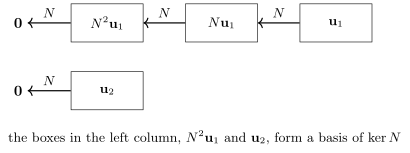
is the picture the proof builds. Each chain is a row of
boxes, the top of the chain on the right, and moves one box to the
left, off the diagram at the left edge. For lengths
:
Idea. Induction on , with the smaller
object found inside: . It is -invariant, is nilpotent, and
because a nilpotent operator on a non-zero space is not
injective. So
already has chains. Each chain of is one box short of
what we want: its top lies in , so for some
, and we
can extend the chain by one box on the right, gaining
. What is still
missing is counted by : the ends of the
extended chains are independent vectors of , and any basis
extension of them inside supplies the
chains of length .
Then the count comes out exactly right, by Rank–Nullity
(Theorem 2.3.1), and
independence follows by applying once and using the
basis of .
Proof. We argue by induction on
,
the statement being: for every nilpotent on a space of dimension
, chains as in (a)
exist.
Base case . Here , as noted after Definition 10.2.1.
Take , and any non-zero vector;
then
and is
a basis.
Induction step. Let and assume the
statement for all spaces of dimension less than . Let be nilpotent
with .
is not
injective: if it were, then would be injective
for every (a
composition of injective maps is injective, Theorem 0.4.3 (a)),
contradicting on . So , and with Rank–Nullity gives (Theorem 2.3.1).
Step 1. Chains inside . If , then ; take , all and any
basis of , and (a)
holds. So assume . Then is -invariant (Theorem 6.7.4 (b)),
is nilpotent
(), and . By the induction hypothesis there are
and with ,
, and a basis of .
Step 2. Lift each chain by one box.
Each lies in
, so we
may choose with for . Put . Then
Step 3. Fill up . The
vectors () are members of the basis , hence linearly
independent, and each lies in , because . By Theorem 1.6.5
applied inside , there are vectors such that is a basis of ; in particular . Put for , so that
for those as well.
Step 4. The combined list is a
basis. Let be the list of all
with
and
, the chains written one after another as in
(a). Its length is by Step 1 and Theorem 2.3.1. So by
Theorem 1.6.4 (a) it
is enough to prove independence.
Suppose with . Apply
to . For
we have
and , so those
terms die. For and we get by Step 2, so those terms die too.
The rest is, using ,
This is a linear combination of the members of
the basis of
, so Substituting these zeros back into leaves only the
terms with and those with : This is a linear combination of the members of
the basis of
from Step 3, so all the remaining coefficients vanish as
well. Hence is
independent, and therefore a basis of . The lengths satisfy
by
the count above, and reindexing the chains so that the
lengths decrease — a permutation of the chains —
arranges . This proves (a), and completes the
induction.
- (b) Each is -invariant of dimension
, and writing
for its chain, by Lemma 10.2.2 (b).
The chains together form the basis of , so .
The sum is direct: if with , then
writing each
in terms of its own chain turns this into a linear
combination of the members of the basis equal to , so every coefficient
is and every
; now
apply Theorem 1.7.5 ((b)
(a)).
Finally Theorem 9.1.5 gives
that is
block diagonal with blocks .
The theorem says that a nilpotent operator carries no
information beyond the list of chain lengths. In matrix
terms: every nilpotent is similar
to for some summing to (apply the
theorem to
and use Theorem 4.2.4).
The index of nilpotency is , the largest block
(it is also the stabilization index of the kernel chain
of Theorem 10.1.1,
since ): and , and powers of a block diagonal matrix
act blockwise (Theorem 8.1.4 (b)).
Two questions remain: are the lengths unique, and how do
we find them without finding the chains? One computation
answers both.
Block
sizes from the ranks of the powers
The lengths are visible in the ranks of the powers of
, which are
similarity invariants. This is the practical algorithm
and the uniqueness proof at once.
Theorem
10.2.4 (Block Sizes from Ranks of
Powers)
Let be
finite-dimensional with , let be nilpotent, and suppose is a Jordan basis for
with chain
lengths , as in Theorem 10.2.3.
Write for , so . Then:
- (a) for every
integer ,
- (b) for every
integer ,
the number of chains of length at least
is
- (c) for every
integer ,
the number of chains of length exactly
is
- (d) consequently the
list is determined by alone: any two Jordan
bases for have
the same chain lengths. Moreover and
is the index of nilpotency of .
Idea. Everything follows from what
does to the
basis: it shifts each chain boxes to the left, so
the surviving images are the boxes at least steps from the left
edge. They are members of the basis, hence independent,
and we can just count them: chain contributes of them, or none
if it is too short. Then (b) is a telescoping
difference, because lengthening the shift by one step
loses one box from every chain that still had one.
Proof.
(a) The basis
consists of the
vectors
with
and . Fix . Applying to a member gives
, which is when , because
,
and is a member of , hence non-zero, when
.
Since the image is spanned by the images of a basis (Theorem 2.2.4), This spanning list is a sublist of the basis
, hence linearly
independent, so it is a basis of and is its length:
for each , the
number of integers with is
if , and otherwise, that is
.
This gives the first formula, and the second follows
from Theorem 2.3.1 and
:
(b) By (a), . For a single , the bracket is if , and if . Summing over counts the indices with
.
(c) Subtract the
count in (b) for from the count for : a chain has length
exactly if and
only if its length is at least but not at least . This gives .
(d) The numbers
are
defined from with
no reference to a basis, so by (c) the number of chains
of each length is determined by ; hence so is the list
of lengths in decreasing order. Taking in (b) gives , which is by Theorem 2.3.1. Finally
and
,
since by (a) and ; so is the
index.
Corollary
10.2.5 (Similarity of Nilpotent
Matrices)
Let , , both nilpotent. Then if and only if
Equivalently, if and only if their chain lengths, as
lists in decreasing order, agree.
Proof. If , say , then
(Proposition 4.2.6
(c)), so (Proposition 4.2.6
(a)).
Since and for every (Theorem 4.1.5
(a)), the hypothesis is a statement about the operators.
By Theorem 10.2.3
applied to
and to ,
together with Theorem 4.2.4,
is similar to
and to , with both lists
decreasing. Equal ranks of all powers force equal lists,
by Theorem 10.2.4 (c)
(the ranks for are all , so the listed range
suffices). Hence
and are similar
to the same matrix, and because similarity is an equivalence
relation (Example (Similarity)).
Warning. The successive
differences count the blocks of size at least , not the blocks of size
exactly ; to get
the exact counts, subtract twice. Suppose and , , . Then chains have
length , have length
, and has length
. Reading
these as exact counts would suggest two chains of length
, two of length
and one of length
, that is, lengths
,
summing to
instead of . The
correct counts are the second differences of Theorem 10.2.4
(c): exactly chains of length , exactly of length , and exactly of length . The partition is , and as it must
be.
Quick check. A nilpotent on a space of dimension
has and . What are
its chain lengths?
Solution. Here , and , so there are
chains by part (b) of Theorem 10.2.4.
Also : a
chain of length would contribute at least to , so every and . By part (c) the
exact counts are chain of length , of
length , and of
length . So the
lengths are , which indeed sum to .
Partitions
and Young diagrams
The data left over is a list of decreasing positive
integers with a given sum. Such lists have a name.
Definition
10.2.3 (Partition of an Integer, Young Diagram,
Dual Partition)
Let . A
partition of is a finite
list of integers Its Young diagram is the
left-justified array of boxes with boxes in row . The dual
partition is the list of
column lengths of the diagram, which is again a partition of .
(The word partition is also used for a
partition of a set into blocks (Definition 0.5.4) and
for a partition of the row and column indices of a block
matrix (Definition 8.1.1).
Those are different notions; here the blocks are boxes
in a diagram and the data is a list of numbers.)
For a nilpotent on a space of dimension
, the chain
lengths form a partition of , and Theorem 10.2.4 (b)
identifies the dual partition: using Theorem 2.3.1 for the
last equality. The rows of the diagram are the
chains; the columns are the jumps of the kernel
chain. In particular the first column is a
basis of
(its boxes are the vectors ), the
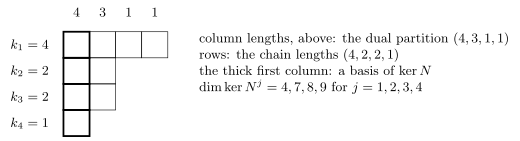
first two columns span , and so on. Here is the diagram for the
partition of ,
with the columns marked:
Reading the diagram by rows gives the Jordan blocks;
reading it by columns gives the dimensions . Transposing the diagram exchanges a
partition with its dual.
Finding a
Jordan basis
The proof of Theorem 10.2.3 is
an algorithm, but run from the inside out. For small
matrices it is easier to work from the longest chain
down, using the rank data to know what to look for.
Algorithm. Jordan basis of
a nilpotent operator.
- Compute until , and read off the chain lengths by Theorem 10.2.4
(c).
- For each length in decreasing order, choose a top
with , keeping
the chains collected so far independent, and write down
its chain.
- Chains of length are vectors completing
a basis of
together with the ends of the
longer chains. Once vectors are collected,
Theorem 1.6.4
confirms a basis.
Example
(A Jordan Basis for a Nilpotent Matrix)
Let Show that is nilpotent, find its
chain lengths, and find a Jordan basis together with an
invertible with
a
direct sum of blocks .
Solution. Nilpotency and
ranks. Multiplying out, the last because every row of is a multiple of
,
while Since , the index is . Rows and of are equal and row
row , so , and . Thus
By Theorem 10.2.4
(c), the number of chains of length is , of length is , and of length is . The partition is : one chain of
length and one of
length , matching
the picture drawn after Theorem 10.2.3.
The long chain. We need .
Try :
the first column of is , so
and
works. Its
chain, read off the first columns of and , is
The short chain. has dimension
(Theorem 3.5.7). The
equations (row )
and (row )
give and
,
so The end of the long chain, ,
is the second of these basis vectors with a minus sign,
so we complete it to a basis of with .
The basis and the matrix. Take the matrix whose columns are the vectors of
. Its third
column has a single non-zero entry, the in row , so expanding along
that column (Theorem 7.6.1) gives
the last determinant computed by expanding
along its own first column. So is invertible and
is a basis.
Then There is no need to invert to check this: the
claim is the same as , which reads
column by column as and these four statements are exactly how the
chains were built (the first and last say that the two
chain ends lie in ). As a sample verification, the second row
of is
,
matching the second coordinate of .
Exercises
A. Check your
understanding
Exercise
(A1)
- (a) Define a
nilpotent operator and its index of nilpotency.
- (b) State the
structure theorem for nilpotent operators, and say what
a Jordan basis is.
- (c) Write down the
formula for the number of chains of length at least
in terms of the
ranks of the powers.
- (d) True or false: a
singular matrix is nilpotent. Justify your answer.
- (e) True or false:
two nilpotent matrices in with the same rank
are similar. Justify your answer.
- (f) How many
similarity classes of nilpotent matrices are there in
, and what
are their indices of nilpotency?
Solution.
(a) is nilpotent
if for
some integer ; the index is the
least such (Definition 10.2.1).
(b) For nilpotent
on with , there
are chains generated by of
lengths summing to whose concatenation is
a basis of
— a Jordan basis
— and (Theorem 10.2.3).
(c) (Theorem 10.2.4
(b)).
(d) False. is singular,
and for every . What is true is
the converse: a nilpotent matrix on a non-zero space is
singular, since (Proposition 10.2.1
(c)).
(e) False for
. The
partitions
and of both give rank , but is and respectively, so the
matrices are not similar (Corollary 10.2.5).
(For the
rank does determine the partition.)
(f) Three, one
for each partition of : , with
indices .
B. Practice
Exercise
(B1: Block sizes from rank data)
In each case
is nilpotent on a space of dimension over . Determine the chain
lengths, or explain why no such operator exists.
- (a) , , , , .
- (b) , , , .
- (c) , , , .
Solution.
(a) With , the exact counts from Theorem 10.2.4 (c)
are: length :
;
length : ; length
: ; length
: . The
lengths are , and .
(b) With : length : ; length
: ; length
: . The
lengths are , summing to .
(c) No such
operator exists. By (b) of the theorem, the number of
chains of length would be , while the number of length would be , which is
impossible: a chain of length has length , so the counts must
be non-increasing in . (Equivalently, Theorem 10.2.4 (c)
would give chains of length , which is
absurd.)
Exercise
(B2: The five classes in dimension four)
Let be any
field.
- (a) List the five
partitions of ,
and for each write down the corresponding nilpotent
matrix in as
a direct sum of blocks .
- (b) For each,
compute ,
, and the index
of nilpotency.
- (c) Which pairs
among them share the same rank? Which invariant
separates each such pair?
- (d) Deduce that
alone is
not a complete invariant of nilpotent matrices, but the
full list of ranks of powers is.
Solution.
(a) : ; : ;
: ;
: ; : the zero
matrix.
(b) Using (Theorem 10.2.4
(a)), the ranks and the index are:
- : ranks
; index
.
- : ranks
; index
.
- : ranks
; index
.
- : ranks
; index
.
- :
ranks ;
index .
(c) Only and share a rank,
namely . They are
separated by (
against ),
equivalently by the index ( against ) or the minimal
polynomial (
against , Proposition 10.2.1
(b)).
(d) The pair in
(c) shows that equal rank does not imply similarity,
while equality of for all does (Corollary 10.2.5).
Exercise
(B3: A Jordan basis by hand)
Let
- (a) Show that and compute
.
- (b) Determine the
chain lengths of .
- (c) Find a Jordan
basis and an invertible with a direct sum
of blocks .
Verify your answer by checking column by
column.
Hint: for (c), the tops of the chains may be
taken among the standard basis vectors.
Solution.
(a) Write for the
columns of , so
,
,
and
. The
columns of are
, so it is enough to check the first two.
Row by row, Hence and , so
. Also
by the relations among the columns, and
are not
proportional, so .
(b) .
Chains of length :
; of length : . So
the partition is : two chains of length .
(c) We need two
tops with
independent; since and , the vectors and do it, with
and . Take The last column of has a single non-zero
entry, the in row
, so expanding
along it (Theorem 7.6.1) gives
where the second determinant was expanded
along its second column. So is a basis, and Column by column, says: (first
column of is
);
(second column of is the first column of ); ; and
. All four were verified in (a) and
(c).
C. Going deeper
Exercise
(C1: A nilpotent matrix is similar to its
transpose)
Let be nilpotent.
- (a) Prove that is nilpotent and
that for every .
- (b) Deduce that
.
- (c) For , find an
explicit with
.
Solution.
(a) (Theorem 0.9.5), so
by Proposition 10.2.1
(a), and
is nilpotent. A matrix and its transpose have the same
rank (Theorem 3.5.5), so
.
(b) Both matrices
are nilpotent with equal ranks of all powers, so Corollary 10.2.5
gives .
(c) sends , , , while
sends
, that is, it is the shift in
the reversed basis. So take the reversal permutation
matrix Then , as one checks column by column:
has
columns , , , and has
columns , , . (The same reversal works for every , and hence,
blockwise, for every nilpotent matrix in Jordan
form.)
Exercise
(C2: One long chain)
Let be
finite-dimensional with , and let be nilpotent
with .
- (a) Prove that there
is a basis of in
which the matrix of is .
- (b) Deduce that
,
and that .
- (c) Show that the
conclusion of (a) fails for on a space of dimension , and say which
hypothesis fails.
Hint: for (a), take a vector outside , which
exists precisely because .
Solution.
(a) Since , there is
with , while
by Proposition 10.2.1
(a). So
generates a Jordan chain of length (Definition 10.2.2),
which is a linearly independent list of vectors (Lemma 10.2.2 (a)),
hence a basis of
(Theorem 1.6.4 (a)).
In it the matrix of is , by Lemma 10.2.2 (b)
with .
(b) In that basis
for
(Theorem 10.2.4 (a)
with the single length ), so by Theorem 2.3.1 and the
index of nilpotency is . Hence by Proposition 10.2.1
(b), and
as well; they coincide, which by Corollary 9.6.2 is the
extreme case .
(c) For on we have , so and
the hypothesis fails. Accordingly is not similar to
: its rank
is , while , and
similar matrices have equal ranks (Proposition 4.2.6
(a)). Its partition is , not .